Category: hotels

  • A Wedding Enquiry Arrives at 11 p.m.: How Hotels Should Handle Group and Event Enquiries Before Sales Opens

    A Wedding Enquiry Arrives at 11 p.m.: How Hotels Should Handle Group and Event Enquiries Before Sales Opens

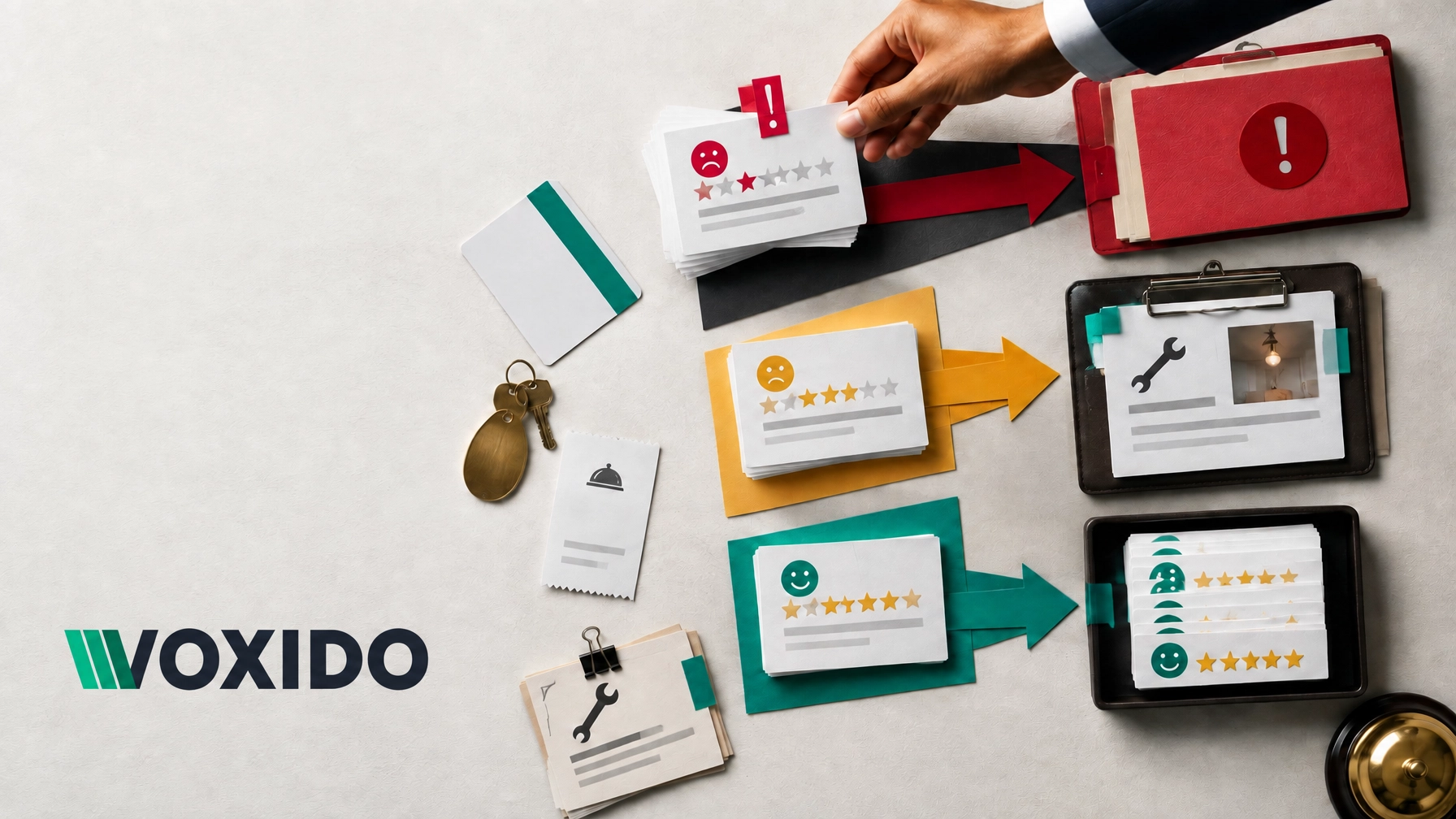
    Illustrative cover: the enquiry is pending sales review; this is not a product screen or a confirmed booking.

    The enquiry lifecycle at a glance

    Illustrative five-step diagram of the group-enquiry lifecycle, from received through acknowledged, qualified and sales-owned to decision sent

    Illustrative workflow diagram, not a product screen.

    How should your hotel respond when a wedding, group or corporate-event enquiry arrives at 11 p.m., before the sales team is back? Acknowledge it promptly, capture the details the guest has shared, and make clear what still needs a sales decision. Do not quote a rate, promise availability, offer a discount or imply that space is being held unless an authorised person has checked and approved it.

    The goal overnight is not to close the event. It is to make sure the prospect knows the message arrived, the essential information is recorded, and a named person has a clear next step.

    What can the hotel answer after hours?

    A responder, staff member or automated channel, can share stable facts that the hotel has approved and keeps current. That may include the types of event spaces, published capacity ranges by setup, general venue features and the usual enquiry process.

    Capacity should be presented as a guide, not a promise: layouts, staging, service requirements and the event date can affect what is practical. If the relevant information is missing, outdated or unclear, say the team will check.

    Leave commercial and inventory decisions to sales or events staff with the right authority:

    Can be shared from approved property information Wait for the authorised sales/events decision
    General descriptions of event spaces and facilities Rates, package pricing, discounts or negotiated terms
    Published capacity ranges, with setup and other relevant conditions Availability of a particular venue or room block on the requested dates
    The hotel’s general enquiry and proposal process A hold on rooms or function space, or any availability guarantee
    The information the team needs to prepare a proposal Contract terms, payment schedules and approval of exceptions

    A useful boundary is simple: property knowledge can help a prospect understand the next step; it cannot substitute for a date-specific inventory check or commercial approval.

    Keep the enquiry’s status clear

    Each step of that diagram is a distinct record, and the distinction matters: “we received your message” should not get mistaken for “sales is handling it” or “the hotel has sent a proposal.”

    1. Received: The enquiry arrives through a channel, such as the website, WhatsApp or phone.
    2. Acknowledged: The hotel confirms receipt and explains what happens next. No decision is implied.
    3. Qualified: The record contains enough information for sales to assess the lead and prepare an appropriate next action. Missing details remain marked as missing.
    4. Sales-owned: A named sales or events person accepts responsibility and records the next action.
    5. Decision communicated: The hotel sends an approved answer, such as a clarification request, a proposal or a decision that the requested arrangement cannot be offered.

    Routing a message to a sales inbox is not the same as accepted ownership. Likewise, a quotation is not a contract, and neither is proof that rooms or space have been booked.

    Say this, not that

    Status Say this Avoid saying
    Acknowledged “Thank you. We’ve received your wedding enquiry and recorded the details you shared. Our events team is scheduled to review it during the next sales shift.” “Your wedding date is confirmed.”
    Qualified “We have the event date, estimated guest count and room requirement. Could you also share your preferred contact method and decision timeline?” “We have everything we need,” when important fields are still blank.
    With sales “A named member of our events team has accepted the enquiry and will follow up by the time we’ve agreed.” “Sales has it,” if no one has accepted responsibility or a next step.
    Quoted “After checking the requested dates and approving the terms, we’ve sent a proposal for your review.” “The rooms are yours,” unless a booking or hold has actually been authorised and recorded.

    Choose any update time to suit your operation. Give the prospect a specific time only if the hotel has set that service rule and can meet it.

    Capture a useful qualification packet

    Create one lead record, even if the enquiry arrives by phone or WhatsApp. Capture what the prospect provides, then mark unanswered fields as unknown rather than filling gaps with guesses.

    • Event type and requested date or date range
    • Estimated guest count
    • Room nights needed, including the number of rooms by night if known
    • Food and beverage needs, such as meal format or event functions
    • Budget range, if the prospect chooses to share it
    • Decision timeline and any proposal deadline
    • Contact person and role, such as planner, organiser or company representative
    • Preferred contact method and any channel permissions or preferences
    • Source and time received, plus the acknowledgement sent
    • Missing information, named owner and next action

    For weddings, an events lead may later ask about ceremony and reception arrangements, guest-room patterns or special setup needs. Corporate enquiries may need meeting-room layouts, AV requirements, catering, billing or procurement details. Collect what is relevant; do not turn the first after-hours response into a long interrogation.

    A hotel sales system can help preserve this context. For example, Amadeus documentation on creating inquiries describes using an inquiry to capture a business lead and notes that creating a booking is required to take guestrooms out of inventory or block function space. That is a product-specific example, not a universal system rule, but it illustrates why an enquiry record and an inventory commitment should remain separate.

    Worked example: a wedding planner messages at 11:23 p.m.

    Illustrative example only. Assume the hotel has chosen a 9:30 a.m. sales review and can reliably send a status update by 10:30 a.m. the next morning.

    At 11:23 p.m., a planner sends a WhatsApp enquiry for a wedding in March and says the group needs 18 rooms.

    At receipt, log the channel and timestamp. Record the event type, month and 18-room requirement as supplied. The exact date, guest count, room nights, food and beverage needs, budget (if the planner wishes to share it), decision timeline and preferred contact method are not yet known.

    In the acknowledgement, thank the planner, repeat the details captured and ask for the most important missing information. Be explicit that no availability, rate or space has been confirmed. For this example, the hotel says the events team will begin reviewing the enquiry at 9:30 a.m. and send a status update by 10:30 a.m., a service choice that the hotel must be staffed to honour.

    In the lead record, mark the enquiry as acknowledged and qualification incomplete. Queue it for the morning review; do not label it sales-owned until a named person accepts it. At the chosen review time, that person checks the record, accepts responsibility and either asks for missing details or proceeds with the hotel’s normal availability and pricing review.

    The hotel may measure the time from 11:23 p.m. to the acknowledgement, then separately record when sales accepts ownership and when the enquiry becomes qualified. These timestamps show whether the handoff worked; they do not imply that a booking was made.

    Set the workflow up before standardising it

    The GM or sales leader should approve the operating rule, with a named events or group-sales owner and a backup. Before making the process standard, or automating any part of it, check that the hotel has:

    • An approved, current knowledge base for venue descriptions, capacity ranges, layouts and general process.
    • A named sales/events owner and backup, including coverage for the next staffed shift.
    • A written after-hours acknowledgement rule with realistic review and update windows.
    • A CRM or lead record that captures the enquiry, channel, timestamp, owner, missing fields and next action.
    • Clear quiet-hours and follow-up preferences, including which channel the prospect wants the hotel to use.
    • A review step for rates, availability, holds and contracts, with the authorised decision-maker identified.

    If a channel or contact preference is unclear, ask before switching to a different method of follow-up. Do not treat a contact detail as permission to send messages through every channel.

    For a more detailed guide to assigning people responsibility for escalations, see when a hotel AI agent should hand off to staff. For planning triggers, messages and handoffs across guest communication, read how hotels build automated guest communication campaigns.

    Measure the handoff, not just the first reply

    Track three basic measures using your hotel’s own service rules, without assuming an industry benchmark:

    • Time to acknowledgement: received timestamp to the first clear receipt confirmation.
    • Time to qualified handoff: received timestamp to a sufficiently complete record accepted by a named sales owner. If the prospect has not supplied key details, keep that gap visible.
    • Enquiries lost or unanswered: count leads with no recorded acknowledgement or owner action, and distinguish those from prospects who decline, go elsewhere or cannot be reached.

    You can also track proposals sent and confirmed business, but keep those outcomes distinct from enquiries received, qualified leads and quotes. To understand cost, compare staff time spent on after-hours capture and follow-up with the eventual outcomes recorded in the sales process.

    Voxido’s currently published hotel and chat pages describe a website chat widget and verified WhatsApp Business number sharing one agent brain, with 24/7 coverage, support for 30+ languages, website lead capture and qualification, and staff escalation with context. Whether a particular CRM workflow and your sales-ownership rules fit your property should be confirmed for your setup. If you are reviewing an after-hours phone or WhatsApp process, bring the scenario to Voxido.
  • How to Answer Late Check-Out and Early Check-In Requests Without Overpromising

    How to Answer Late Check-Out and Early Check-In Requests Without Overpromising

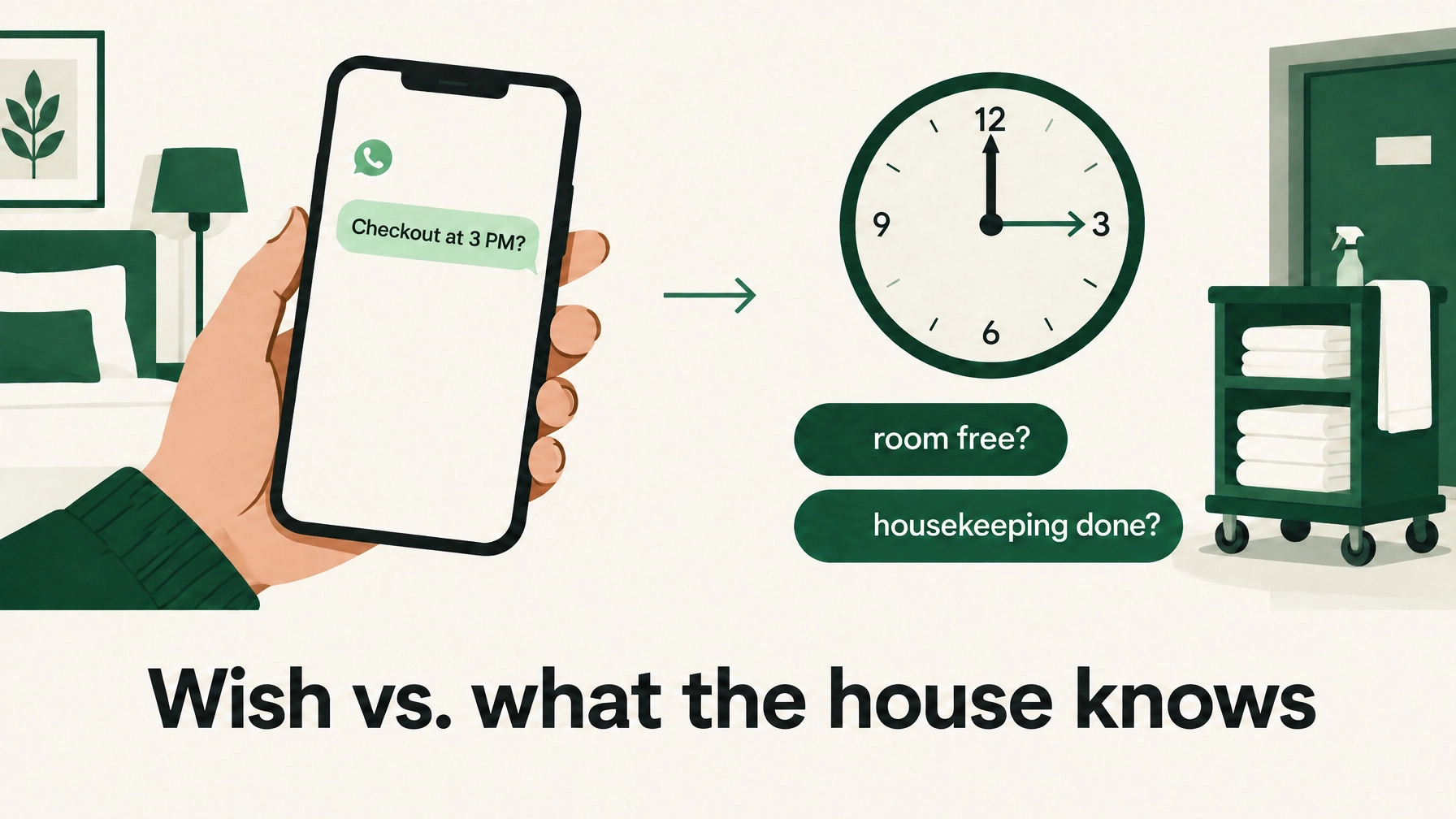
    A guest asks on WhatsApp: “Can I check out at 3 p.m.?” What should the hotel say?

    Confirm only what the published policy already guarantees. If the answer depends on occupancy, room readiness or housekeeping, acknowledge the request and check before deciding. If a fee or policy exception is involved, route it to someone with pricing authority. Never say “approved” until the decision has been recorded.

    The same principle applies to early check-in. A guest’s request is not an approval, and an estimated room-ready time is not a guarantee.

    Why these requests need a clear process

    Early check-in and late check-out sound straightforward, but the decision may depend on information the first person answering does not control: room status, housekeeping capacity, incoming arrivals, occupancy and the hotel’s fee rules.

    The risk is not simply a slow or unfriendly reply. It is an accidental promise that conflicts with the room’s actual status, the next guest’s arrival or the hotel’s policy.

    A useful workflow gives staff three things: a clear boundary for what they may confirm, a named owner for decisions, and language that tells the guest exactly what is known, and what is still being checked.

    Use three decision tiers

    Apply the tiers to either request. For early check-in, check whether the room is vacant, cleaned, inspected and released, not just whether a departure is expected. For late check-out, check the next arrival and whether housekeeping can turn the room around in time.

    Tier When it applies What the responder should do Decision owner Useful measure
    1. Within published policy The booking or loyalty benefit clearly includes a stated time, or the request is already guaranteed under the hotel’s policy Confirm the exact time and any published conditions Front desk Request-to-confirmation time
    2. Needs a check The answer depends on occupancy, room readiness, housekeeping or the next arrival Acknowledge the request, say what is being checked, and give a realistic update time. Do not imply approval. Front-office supervisor or duty manager Request-to-decision time
    3. Chargeable or an exception A fee, rate decision or departure from policy is involved Gather the relevant facts and route the request to the person authorised to decide Front-office manager or revenue owner with pricing authority Decision time and, if charged, billing accuracy

    For a late check-out, relevant facts may include the next arrival’s status, room type and housekeeping turnaround. For an early check-in, check the specific room’s current status and release, not only the expected departure time. A room that is vacant may still be unclean, under inspection or blocked for maintenance.

    The times in any guest update are choices for your property to set, not industry standards. Choose a window your team can meet across operating hours, including overnight.

    Illustrative three-lane decision diagram for late check-out requests: confirm within policy, acknowledge and check, or route a chargeable request or exception to the pricing owner

    Illustrative decision diagram, not a product screen.

    Say this, not that

    Keep each message aligned with the request’s actual status. A request received, a team member accepting responsibility, a recorded decision, a guest notification and completion are separate events.

    Request recorded:
    “Thanks for asking. I’ve recorded your request for a 3 p.m. check-out.”

    Being checked:
    “I’ve asked the duty manager to check the room and housekeeping schedule. I’ll update you by 11 a.m.”
    Use a specific update time only if your team has chosen it and can reasonably meet it.

    Approved:
    “Your late check-out is approved until 2 p.m. Please check out by then so housekeeping can prepare the room for the next arrival.”

    Declined, with an alternative:
    “We’re unable to extend check-out today because the room is needed for an incoming arrival. We can store your luggage after check-out.”
    Offer luggage storage, lounge access or another option only if your property actually provides it.

    “Sent to the manager” means the request has been routed; it does not mean the manager has accepted ownership or approved the request. Likewise, an approval is not proof that the guest has been notified or that a related operational task is complete.

    For a more detailed distinction between a request and an authorised decision, see the hotel staff-handoff guide. If the request arrives in a language the team cannot read, this practical guide covers how to acknowledge before verifying.

    Worked example: a late check-out request

    Illustrative assumptions, not a Voxido or customer result.

    At 9:40 a.m., an in-house guest sends a WhatsApp message asking to check out at 3 p.m. The front desk checks the PMS and sees a confirmed arrival in the same room that evening. Housekeeping needs time to turn it around.

    The responder acknowledges the request and explains what is being checked, without saying it is approved. The duty manager checks the next arrival’s expected time and the housekeeping plan. The manager may approve a shorter extension, such as 2 p.m., if the operational facts and policy allow it. Otherwise, the manager declines and the hotel offers a suitable available alternative, such as luggage storage. The guest receives the decision, not a promise while the decision is still pending.

    A practical workflow record should capture:

    • Trigger: A guest asks for early check-in or late check-out on any channel.
    • Audience: The guest and the staff member or team responsible for the decision.
    • Required information: Booking reference; relevant room and occupancy status; arrival or departure details; housekeeping turnaround; and applicable policy or rate rules.
    • Timing: As a property-set choice, acknowledge within a few minutes and make the decision by the update time given to the guest.
    • Action: Reply using the correct state: recorded, being checked, approved or declined.
    • Exception owner: The named duty manager or pricing-authorised manager, including an out-of-hours backup.
    • Outcome measures: Request-to-decision time, housekeeping or arrival conflicts, and repeat contacts about the same request.

    Set the rules before standardising or automating

    Before introducing a script or communication tool, agree on:

    1. A written early check-in and late check-out policy, including the actual standard times.
    2. Published fee rules and who may approve a charge or exception.
    3. A reliable way to check relevant PMS information, such as room status and arrivals.
    4. An agreed housekeeping turnaround estimate and a process for confirming room readiness.
    5. A named decision owner and backup for every shift, including out-of-hours coverage.
    6. A record of the request, owner, decision, guest notification and operational completion.

    Without these basics, a faster first reply may still leave the guest waiting for a decision, or create a promise the team cannot honour.

    Measure the decision, not just the reply

    Track request-to-decision time, the share of requests approved and declined, housekeeping or arrival conflicts, and repeat contacts about the same request. If late check-out is sold, track the related revenue separately and check billing accuracy. Do not treat an approval as revenue or set a revenue target before you know what your hotel’s own records support.

    Whatever tool answers the first message, the workflow and authority rules still matter. Voxido’s hotel offering describes guest communication across voice, chat, WhatsApp and SMS, support for 30+ languages, integrations including Cloudbeds and Hostaway, and staff escalation with context. Whether it fits your property’s systems and the specific decision workflow above is something to verify for your setup.

    Use the three-tier table to review this week’s early check-in and late check-out requests. Then, if you want to discuss how the workflow might fit your hotel’s guest communications, bring the scenario to Voxido.

  • Asking for Reviews Without Breaking the Rules

    Asking for Reviews Without Breaking the Rules

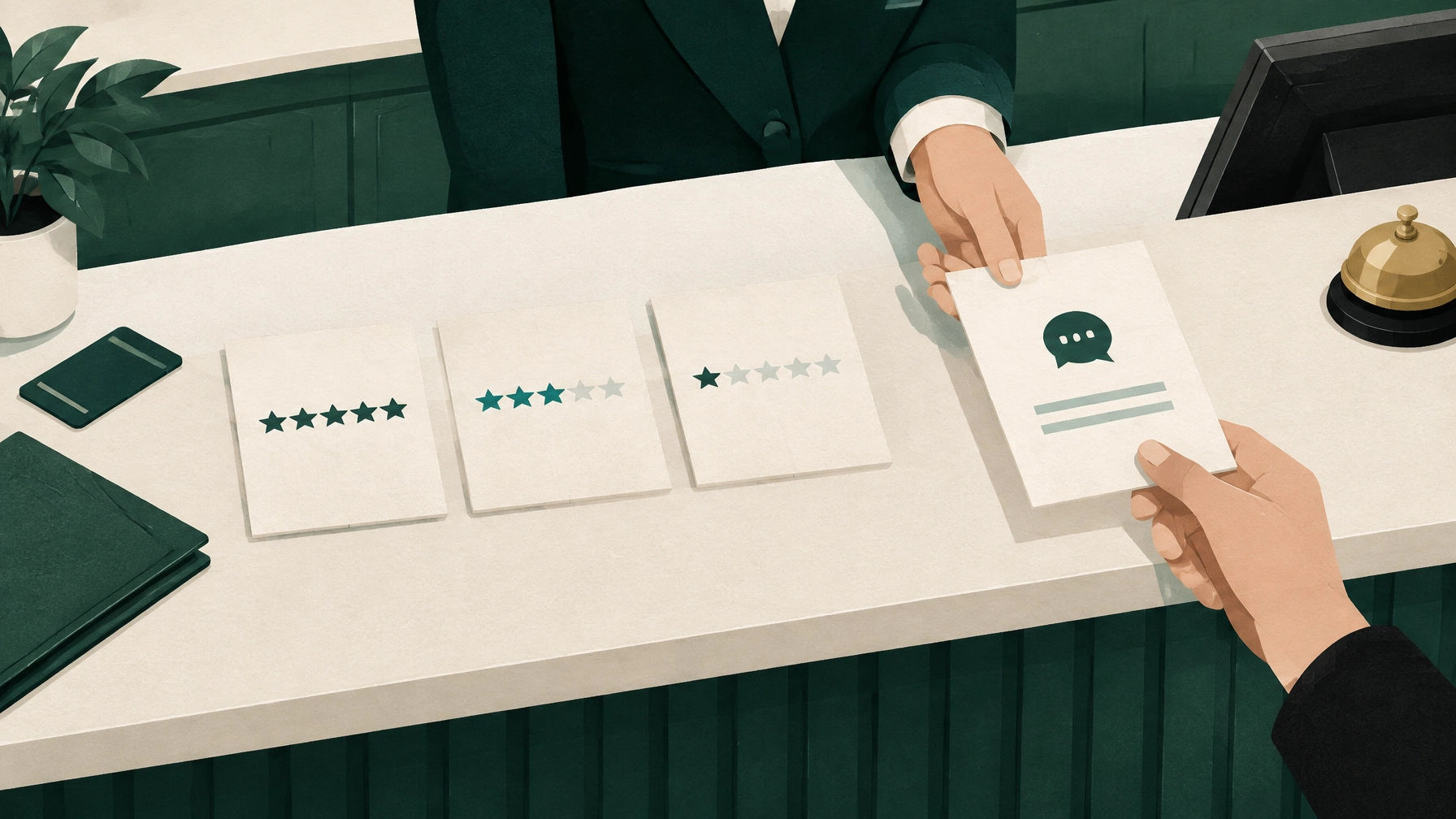
    How can a hotel ask guests for reviews consistently without steering the rating? Use the same neutral invitation for every eligible guest, ask for an honest account of their stay, and keep any service-recovery conversation separate from the review request. Do not reward reviews, ask only guests you expect to be happy, or pressure anyone to give a particular rating.

    That approach is practical as well as fair: guests can describe their own experience, and the hotel can learn from the feedback without shaping who gets asked or what they say.

    Why hotels get review requests wrong

    The temptation is understandable. A five-star average looks good, and a disappointing review can feel like an urgent problem to contain. But trying to control which reviews appear can undermine the credibility of the feedback, and may breach platform rules.

    Three habits deserve particular attention:

    • Review-gating: asking guests privately whether they were happy, then inviting only satisfied guests to post publicly.
    • Rewards for reviews: offering a discount, upgrade, meal or other benefit in return for a review, a particular rating, or changing or removing a negative review.
    • Rating-linked staff incentives: rewarding employees for five-star reviews or a target average. This can pressure staff to solicit specific ratings or ask for reviews selectively.

    A private feedback form can help identify problems. It should not become a filter that sends likely positive guests to public review pages and diverts unhappy guests away from them.

    What the rules say

    Google Maps

    Google says Maps reviews should reflect genuine experiences. Its policy prohibits paying for reviews, offering discounts or free goods and services in exchange for reviews, and asking for a revision or removal of a negative review in exchange for an incentive. It also specifically says merchants must not discourage negative reviews or selectively solicit positive ones. Google does allow merchants to invite reviews that reflect genuine experiences, without incentives or attempts to influence the rating or content. Read Google’s Maps user-generated content policy.

    The practical takeaway is direct: make the invitation neutral and apply it consistently. Do not ask guests to include specific phrases, mention a staff member, or give a particular number of stars. Google also says merchants should not pressure guests to write reviews while they are on the premises.

    The United States FTC rule

    The US Federal Trade Commission’s Consumer Reviews and Testimonials Rule, 16 CFR Part 465, took effect in 2024. It prohibits incentives conditioned on a review expressing a particular sentiment, whether positive or negative, and addresses fake or false reviews and certain forms of review suppression.

    This is US regulation, not an Indian law. Hotels operating in the United States should consider the rule in their compliance process. For hotels elsewhere, it is useful context, but platform rules and local requirements still need to be checked independently.

    India

    India’s Department of Consumer Affairs reported that the Bureau of Indian Standards published IS 19000:2022, a standard for collecting, moderating and publishing online consumer reviews, on 23 November 2022. The government described it as voluntary and applicable to online platforms publishing consumer reviews. Its guiding principles include integrity, accuracy, privacy, transparency and responsiveness. Read the Government of India announcement.

    That announcement is not a blanket statutory rule governing every hotel’s review invitation. For questions about a property’s legal obligations, consult an appropriate local adviser. Regardless of jurisdiction, checking the rules of each review platform, and the hotel’s agreements with OTAs, is a sensible operating safeguard.

    Asking versus filtering

    A consistent, neutral approach Avoid
    Invite every guest in the defined eligible group to share an honest review. Invite only guests who seem satisfied or had an especially good interaction.
    Use the same wording and process across the group. Offer discounts, gifts, upgrades or other rewards for reviews.
    Make it easy to find the relevant review page, without suggesting a rating. Ask for five stars, specific wording or a named employee in the review.
    Welcome honest feedback, positive or negative. Send unhappy guests only to a private form while directing happy guests to public review pages.
    Respond to public reviews and handle service issues through a separate recovery process. Ask a guest to change or remove a negative review in return for a benefit.

    A hotel can invite private feedback as well as public reviews. The important distinction is whether both options are offered without using a guest’s response to decide who gets the public-review invitation.

    A neutral message hotels can adapt

    Suggested timing choice: Send the request 24–48 hours after checkout. This is a choice, not a universal rule or platform requirement. Sending it after departure also avoids putting a guest on the spot at reception.

    Thank you for staying with us at [Hotel name]. If you would like to share an honest review of your stay, you can do so here: [review link]. All feedback is welcome and helps us understand what worked and what we can improve. Thank you for taking the time.

    Use the same invitation for every guest in the group. Do not add a reward, ask for a star rating, or imply that the hotel expects a positive review. If a guest has raised an issue, the hotel may also follow up privately to address it, but that conversation should not replace or condition the neutral invitation.

    For Google and OTAs, use the review process and links permitted by each platform. OTA terms and partner agreements may set additional conditions on direct solicitation, so check the relevant contract before adding an OTA-specific link or campaign.

    What to do when a guest is unhappy

    A complaint raised privately is an opportunity to understand and address an operational issue, not a reason to withhold a public-review invitation. Keep the two processes separate:

    1. Record the issue and route it to the appropriate owner.
    2. Acknowledge the guest without promising an outcome that has not been approved.
    3. Investigate and act through the hotel’s service-recovery process.
    4. Invite an honest review consistently, regardless of whether the issue was resolved.
    5. Track the operational outcome separately from whether the guest posts a review.

    The hotel’s existing guest-review triage workflow can help assign ownership and distinguish a published response from a completed service fix. A review invitation should never be presented as the price of receiving help.

    Team rules and a simple check

    The GM or designated reputation owner should approve the process. Front-office and marketing teams can share the approved message, but should not improvise incentives or change the invitation based on a guest’s reaction.

    Before launch, confirm:

    • Trigger: Checkout is recorded.
    • Audience: Every guest in the defined eligible group, not a satisfaction-selected subset.
    • Required information: A valid contact channel, the correct stay status, the approved message, and the appropriate review link.
    • Timing: A property-selected interval after checkout, with channel permissions and contact preferences respected.
    • Action: Send the same neutral invitation; record whether it was sent.
    • Exception owner: A named manager handles complaints, opt-outs, suspected errors and requests requiring judgement.
    • Outcome measures: Track eligible stays, invitations sent, delivery issues and service-recovery closure. Do not tie staff pay to star averages or set a target for positive reviews.

    Review the process periodically. Check whether the invitation went to the full eligible group, whether the wording stayed neutral, whether the right link was used, and whether service issues reached an owner. The goal is a reliable invitation process and useful feedback, not a particular rating.

    If you are considering automating review invitations through WhatsApp, first confirm that the chosen system and channel setup support your intended workflow and permissions. Keep the wording consistent and retain human oversight for exceptions. To discuss how a hotel phone or WhatsApp workflow might fit your operation, bring the scenario to Voxido.
  • When a Guest Writes in a Language Your Team Cannot Read: A Practical Hotel Guide

    When a Guest Writes in a Language Your Team Cannot Read: A Practical Hotel Guide

    A guest sends a WhatsApp message in a language nobody on shift can read. What should the hotel do? Preserve the original message, use translation only to understand the likely request, classify it by consequence, and route it to someone qualified to answer. For a routine question, a carefully checked translated reply may be enough. For anything involving money, a booking change, health, safety, legal terms, accessibility, or a serious complaint, get human review before promising an outcome.

    The key is to treat machine translation as a bridge to understanding, not as proof that the hotel has understood the guest correctly. If nobody can verify a consequential reply, acknowledge the message, explain that a team member is checking it, and make the handoff explicit.

    Why this is an operating problem, not a translation problem

    Language coverage changes by shift. A property may have someone who reads a guest’s language during the day but no such person at night. At 11 p.m., an unfamiliar-language message can sit unseen, or prompt a confident guess from a staff member who catches only a few words.

    Neither silence nor a guessed reply resolves the request. The operational question is: who owns the next step, and what can they safely tell the guest while they check?

    Set a process that works when the right language speaker is not on duty. That may mean using an approved translation tool for triage, contacting an on-call colleague or language professional, or acknowledging the message and giving a realistic update time. Choose the method based on your staffing and the risk of the request.

    The four tiers of language handling

    Classify the message by what could go wrong if it is misunderstood, not by its length or apparent simplicity.

    Situation Who handles it What is safe What must not happen Suggested outcome metric
    Routine information, in a language covered on shift Staff member who can read it; another team member may help with the approved reply Answer using current property information; clarify if the request is ambiguous Guess about availability, policy, or an exception Correct resolution without repeat contact
    Routine information, in a language nobody on shift reads Designated language owner or staff member using an approved translation workflow Use translation to identify the question; send only a simple, verified factual reply Let a rough translation turn into an unverified commitment Time to a clear answer
    Consequential message: payment, cancellation, refund, complaint, safety, medical, legal, or accessibility The relevant human owner, such as reservations, finance, duty manager, or the designated safety contact Use translation for initial triage; preserve the original; have a qualified person verify meaning and response Approve, refuse, diagnose, interpret rights, or promise a remedy based only on machine translation Time to accepted human ownership; unresolved cases
    Mixed-language or partially understood message Staff member who owns the request, with language help if needed Ask a short clarifying question; handle only the part clearly understood Treat partial comprehension as full confirmation Repeat-contact rate; clarification resolved

    These metrics are suggestions for your property, not industry benchmarks. If a message indicates immediate danger, follow the hotel’s established emergency procedures and contact the appropriate emergency service. Do not rely on translation as a substitute for emergency response.

    What machine translation can and cannot be trusted with

    Machine translation can help staff triage a message or draft a reply to a simple, routine question. For example, it may help identify that a guest is asking about breakfast hours. But fluent wording is not the same as verified meaning.

    Pay particular attention to names, room types, dates, times, amounts, currencies, cancellation terms, and booking references. A 2025 research paper tested how translation systems preserved entities such as phone numbers, email addresses, and URLs across four languages. It identified cases where these details were changed or omitted. The study used a specific test dataset; it is not a test of hotel conversations. Still, it illustrates why exact details should be checked rather than trusted to survive translation unchanged. Read the research paper.

    Food allergies, dietary needs, medication, symptoms, legal language, consent, and accessibility requests require even greater caution. A translated phrase can miss a key distinction or fail to capture the guest’s intended tone. Guidance from the National Center for State Courts is written for courts, not hotels, but it similarly cautions against relying on machine translation alone for complex or high-consequence information, and recommends human review. Read the NCSC guidance.

    For consequential messages, a human should review both what the guest wrote and what the hotel plans to say. If the hotel cannot verify a promise, do not make it through a chain of translations.

    Where the guest gets lost

    A handoff can fail even when the right department is contacted. If the guest has to repeat everything to a second person, they lose time and may feel that nobody has understood them. Tone and context can also disappear in a brief summary.

    Give the next owner a handoff packet containing:

    • The original message in the guest’s language.
    • The working translation, clearly marked as unverified if it has not been checked.
    • The guest’s channel and the time the message arrived.
    • Relevant booking or room context, shared only through approved channels.
    • What the hotel has already told or promised the guest.
    • The named person or team responsible for the next update.

    Keep the request, accepted ownership, decision, guest notification, and completed action distinct. “I’ve sent this to reservations” does not mean the change has been approved.

    Decide your language coverage deliberately

    Start with the languages guests actually use in messages, not assumptions based on nationality or market. Review real, appropriately handled message data and booking patterns. Then decide which languages need written coverage, spoken coverage, or both.

    A realistic 24/7 plan does not have to mean a fluent employee for every language on every shift. It does need a dependable fallback: who can review an important message after hours, which translation tools are approved for initial triage, and what staff should tell a guest while human help is arranged. Make coverage commitments that match the people and services you can actually reach.

    A five-step setup checklist

    Step Action Owner Prerequisite data
    1 Identify the languages guests use from real message records Front-office or guest-relations lead Message-language records, channel, shift, and message category
    2 Classify messages by consequence, not length GM or front-office manager with department leads Examples of routine, financial, safety, medical, legal, and accessibility requests
    3 Decide which categories may receive an automatic or staff-checked reply, and which require a person GM and relevant policy owners Approved property answers, authority limits, and escalation rules
    4 Assign the escalation path, including who owns it out of hours Duty manager or operations lead On-call contacts, backup owner, approved communication channel, and acknowledgement process
    5 Review translated conversations monthly for recurring errors and unclear replies Front-office manager with language support Original messages, translations, replies, handoff records, and privacy-approved review access

    Before adopting a translation tool, check how it handles guest data and who may access conversation records. Keep health, payment, identity, and other sensitive details out of unapproved tools and broad staff channels.

    Worked example: illustrative assumptions

    All details below are illustrative assumptions, not a Voxido or customer result.

    At 11 p.m., a guest sends a WhatsApp message in a language nobody on shift reads. A translation suggests they want to change their dates and mentions a food allergy.

    1. The night-shift employee preserves the original message and uses the hotel-approved method to understand the likely request.
    2. They treat the date change as unconfirmed. Reservations must check availability, policy, and any price difference before accepting it.
    3. They treat the allergy as a safety-related disclosure. The message goes to the designated food-and-beverage or duty owner for human confirmation. No dish is described as safe until the hotel has verified it.
    4. The employee sends a brief, approved acknowledgement in a language the hotel can verify, or uses the agreed fallback to arrange language support. It should say that both requests have been received and are being checked, not that either has been approved.
    5. The guest is updated once a responsible person accepts the handoff. The hotel records the date-change decision separately from the food-safety confirmation.

    The essential outcome is not a fast translation. It is a verified decision and a clear update that does not claim more than the hotel knows.

    What to measure

    Track response time by language, the share of messages needing human review, repeat-contact rate, reported mistranslation incidents, and whether guests indicate that they understood the final answer. Review examples monthly to spot recurring confusion, for instance, a room-type name that is routinely misread or a reply template that needs clearer wording.

    Use these measures to improve the process, not to pressure staff into answering beyond their confidence or authority.

    Make language coverage a service standard

    A guest should not have to rely on luck, the right person happening to be on shift, to receive a careful response. Define what staff can answer, when translation is only for triage, and who takes ownership when the meaning or consequences are uncertain.

    Hotel teams considering technology for guest messaging can review Voxido’s hotel offering as one option for phone and messaging workflows with human escalation. Check current language coverage, supported actions, data handling, and fit for your property before relying on any provider.

  • When Should a Hotel AI Agent Hand Off to Staff? A Practical Escalation Matrix

    When Should a Hotel AI Agent Hand Off to Staff? A Practical Escalation Matrix

    The decision board is an illustrative framework for hotel guest-message routing.

    When should a hotel AI agent hand off to staff?

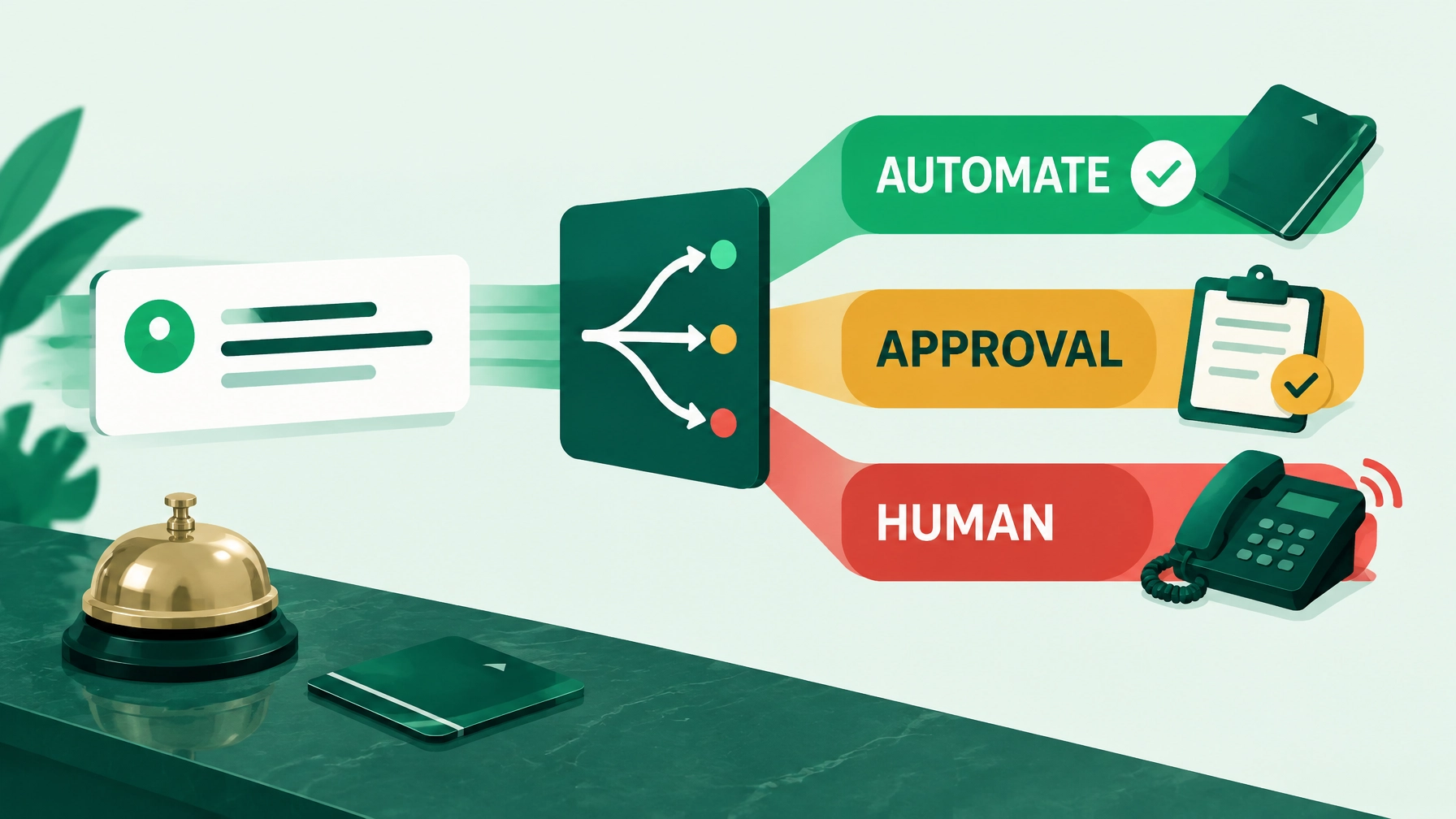
    Hand off whenever the request involves risk, judgment, emotion, missing authority, or an explicit request for a person. Let the agent handle routine, well-defined questions. Let it prepare the context for staff when a decision is needed. Move immediately to a human for safety, security, serious complaints, payment disputes, or distress.

    The goal is not to automate every message. It is to automate the right messages while making human intervention faster and better informed.

    The four-level hotel escalation matrix

    Use four levels rather than a simple “AI versus human” rule.

    Level Suitable guest situations Recommended owner Suggested timing choice Required data Exception or handoff Outcome metric
    1. Automate Property timings, amenities, directions, cancellation policy, booking availability, routine pre-arrival questions AI agent Immediate response, subject to your quiet-hours policy Approved property knowledge and, where relevant, reservation dates Escalate if the answer is unavailable, ambiguous, or outside approved policy Correct-answer rate; self-service completion
    2. Automate, then notify Extra pillow request, airport-transfer enquiry, restaurant hours, standard late-checkout request within policy AI agent, with the relevant operations team notified Notify the owner immediately or within 15 minutes, depending on urgency Guest identity, room or booking reference, request details, delivery location Escalate if the task is not accepted, delayed, unavailable, or changes the guest’s entitlement Request acceptance rate; completion time
    3. Require staff approval Discount, complimentary upgrade, exception to cancellation policy, compensation, group-booking change, VIP request Front-office supervisor, reservations lead, revenue manager, or duty manager Route for approval within 15 minutes or the next staffed operating block Reservation context, policy involved, requested exception, availability, guest history if permitted AI may collect facts but must not promise the outcome Approval time; decision accuracy; guest notification rate
    4. Immediate human handoff Fire, smoke, medical distress, security concern, harassment, suspected fraud, serious complaint, legal threat, or explicit request for a manager Duty manager, security, front desk, or the designated emergency owner Immediate live routing; use the property’s emergency procedure Exact guest message, room or location, contact channel, timestamp, minimal necessary context The agent should not diagnose, investigate beyond what is necessary, or make guarantees Handoff acknowledgement time; incident closure; escalation compliance

    These are suggested timing choices, not universal service-level promises. Each property should set timings based on staffing, operating hours, room count, and the seriousness of the request.

    Cloudbeds provides one example of how hotel technology can combine automated guest messaging with unified inboxes, tickets, tasks, workflows, and team collaboration. Its documentation also describes event-based automated messages linked to reservation or room events. These are examples from Cloudbeds, not requirements for every hotel. See Cloudbeds Guest Experience and its automated messages documentation.

    The rule: automate the action, not the accountability

    A common implementation mistake is treating a guest’s request as if it were already an accepted task.

    A reliable workflow keeps five events separate:

    1. Request: The guest asks for something.
    2. Accepted ownership: A named team or staff member accepts responsibility.
    3. Recorded decision: The hotel approves, declines, modifies, or clarifies the request.
    4. Guest notification: The guest is told what the hotel decided.
    5. Completion: The requested action is actually delivered or closed.

    For example, “I have informed housekeeping” is not the same as “housekeeping accepted the task.” Similarly, “your late checkout is being reviewed” is not approval.

    An AI agent should use precise language:

    • “I’ve recorded your request and sent it to the front desk.”
    • “The front desk has accepted this request and will update you by 2:00 p.m.”
    • “Your late checkout is approved until 2:00 p.m.”
    • “The extra towel has been delivered.”

    This distinction prevents false reassurance and gives managers a useful audit trail.

    What must be in place before you automate

    An escalation matrix only works when the operating conditions are defined.

    1. Approved property knowledge

    Create a controlled source for room types, facilities, policies, timings, transport information, accessibility details, and frequently asked questions. Mark information that changes frequently, such as restaurant hours or pool closures.

    2. Reservation context

    The agent should know when it is necessary to verify a booking, room number, arrival date, departure date, or guest identity. Do not expose reservation information until the hotel has defined an appropriate verification step.

    3. A named staff owner

    “Front desk” is a department, not an owner. Assign queues or individuals for reservations, housekeeping, engineering, billing, guest relations, and duty management.

    4. An escalation channel

    Choose where urgent handoffs arrive: a duty phone, front-desk queue, task system, or another approved staff channel. Define what happens when the primary owner does not acknowledge the handoff.

    5. An audit log

    Record the original message, the escalation reason, relevant context, staff acceptance, decision, guest notification, and completion status. This is essential for coaching and for identifying repeated failure points.

    6. Consent, privacy, and quiet hours

    Collect only the information needed to resolve the request. Avoid placing payment credentials, identity documents, health details, or unnecessary personal information into broad staff channels. Define when outbound calls or WhatsApp messages are permitted, especially for sleeping guests and families.

    An illustrative handoff example

    Assumptions: A hotel has an approved knowledge base, reservation lookup, a duty-manager contact, and a housekeeping task process. The timings below are illustrative choices, not measured Voxido or customer results.

    At 10:15 p.m., a guest messages: “Can you send two extra pillows to room 408?”

    The agent can handle this at Level 2:

    • Request: Two pillows for room 408.
    • Required data: Verified room number and quantity.
    • Action: Create or submit the housekeeping request.
    • Accepted ownership: Housekeeping acknowledges the task.
    • Guest notification: “Housekeeping has accepted your request.”
    • Completion: Staff mark the delivery complete.
    • Metric: Time from request to completion.

    The guest then adds: “Also, the room smells of smoke and I feel unsafe.”

    The workflow immediately changes to Level 4:

    • Trigger: Safety concern and a potential property-condition issue.
    • Action: Stop routine automation and route to the duty manager or the hotel’s designated emergency owner.
    • Guest communication: Acknowledge the concern, explain that a team member is being connected, and provide only approved safety instructions.
    • Exception: Do not diagnose the source, promise compensation, or claim that the issue is resolved.
    • Metric: Time until a responsible staff member acknowledges the handoff.

    One conversation can therefore contain multiple escalation levels. The agent should reassess after every material new message.

    Illustrative framework showing the trigger, context, owner, and outcome required for an AI-to-staff handoff

    Illustrative framework: a handoff packet should give staff the trigger, context, owner, timing, and expected next step.

    A practical seven-day pilot

    Do not begin by automating every guest communication channel. Choose one workflow, such as routine phone or WhatsApp enquiries and service requests, then measure the handoffs.

    Day Pilot activity What to record
    Day 1 Select 20–30 common message types and place each into one of the four levels Category, owner, risk, and approved response
    Day 2 Prepare property knowledge and handoff scripts Missing facts, ambiguous policies, and privacy concerns
    Day 3 Test routine questions and low-risk requests Correctness, completion, and unnecessary escalations
    Day 4 Test exceptions, complaints, and explicit human requests Whether the right staff owner receives the context
    Day 5 Test urgent scenarios using a controlled internal exercise Acknowledgement time and escalation compliance
    Day 6 Review transcripts with front-office and operations leads Repeated questions, loops, unclear ownership, and false promises
    Day 7 Decide what to expand, revise, or keep human-only Self-service completion, handoff quality, completion time, and guest feedback

    The person responsible should be the front-office leader or GM, with input from reservations, housekeeping, engineering, and duty management. Review not only whether the AI answered correctly, but whether the hotel completed the underlying task.

    Where Voxido may fit

    Voxido can be evaluated for hotel phone and WhatsApp workflows where routine guest communication needs structured routing and human handoff. The right design depends on your property’s approved knowledge, reservation context, staffing model, escalation channels, and current technical capabilities.

    Before deployment, ask for a fit check covering:

    • Which phone and WhatsApp workflows are supported today
    • What reservation context the agent can use
    • How staff handoffs are delivered and acknowledged
    • What audit information is retained
    • How privacy, consent, and quiet hours are configured
    • Which actions remain staff-controlled

    The best starting point is usually not “How much can we automate?” It is “Which requests have clear rules, and which decisions must remain accountable to a person?”

    Use the matrix above to classify one workflow, assign its owners, and run the seven-day pilot. To discuss how this could apply to your hotel’s phone or WhatsApp operations, book a Voxido demo.

  • Hotel WhatsApp Costs Change on October 1, 2026: A Budget and Setup Checklist

    Hotel WhatsApp Costs Change on October 1, 2026: A Budget and Setup Checklist

    What will it cost your hotel to message guests on WhatsApp after 1 October 2026-and how should you design guest communication so unnecessary messages do not increase the bill?

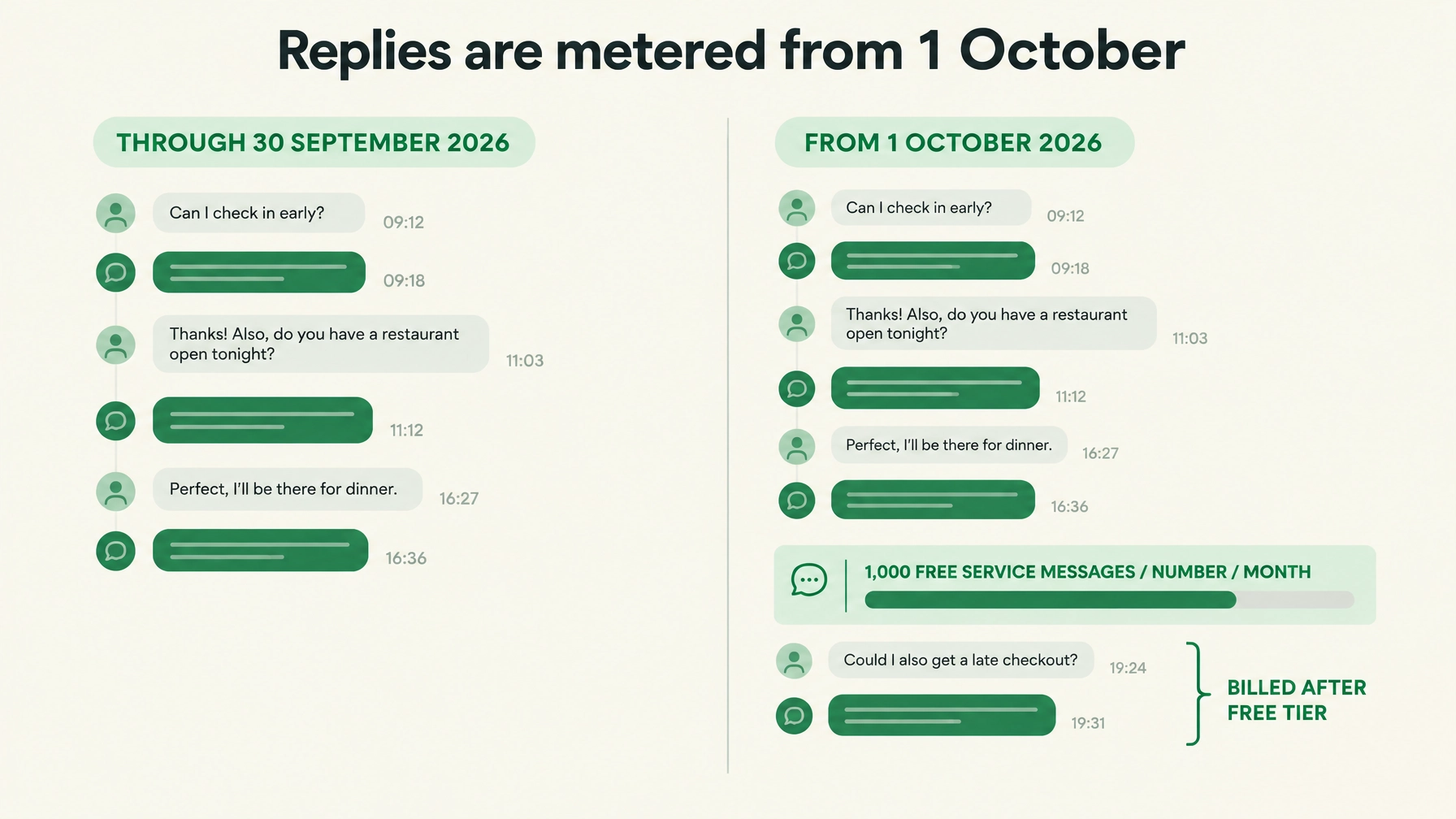
    The direct answer is that Meta will charge per delivered service message on the WhatsApp Business Platform from 1 October 2026. Each business phone number will have a shared monthly free tier of 1,000 delivered service messages. After that tier is used, service messages become billable according to the applicable market rate card. Your budget will therefore depend on delivered message volume and category, not simply on whether a guest replied within the 24-hour window. Meta’s pricing documentation is the source to use for current market rates.

    What actually changes on 1 October 2026

    The important distinction is between a service message, a utility template, and a marketing template. They may all be sent through WhatsApp, but they are not treated the same way.

    Message type Through 30 September 2026 From 1 October 2026 What it means for a hotel
    Service message: non-template reply inside the 24-hour window Not charged Charged per delivered message after the free tier Count guest-support replies, not only outbound campaigns
    Utility template in response to a user inside the window Not charged Charged per delivered message A booking or service update can still be billable inside the window
    Utility template sent outside the window Charged by the utility rate card Charged by the utility rate card Budget for messages that must use templates after the window closes
    Marketing template Charged by the marketing rate card Charged by the marketing rate card Keep promotions separate from genuine service communication

    Meta’s published October update says service rates will match utility and authentication rates by market. It also introduces the 1,000-message service free tier and makes utility messages sent in response to users inside an open 24-hour customer service window chargeable. These changes are effective 1 October 2026, not before. Read the full Meta pricing update.

    The free tier, read carefully

    The free tier is not 1,000 messages for your entire hotel group or business portfolio. It is:

    • 1,000 delivered service messages
    • Per business phone number
    • Per month
    • Shared across one-to-one and group service deliveries
    • No rollover of unused messages
    • Reset monthly for each business phone number

    A one-to-one service delivery consumes one unit. A group service delivery consumes one unit for each delivered recipient. This means your hotel must count delivered recipients, not simply the number of send actions initiated by a staff member or system.

    The free tier also does not apply to every WhatsApp message. It concerns service messages. Marketing and utility templates continue to follow their respective category rules and rate cards.

    There is also an operational risk if the account has no payment method. Meta says it will deliver service messages within the free tier but will not deliver them after the free tier has been used if no payment method is available. Finance or the account owner should therefore confirm billing readiness before October.

    Why category, not channel, now drives the bill

    A hotel may think, “We use WhatsApp for guest service, so our WhatsApp cost is one line item.” That is too broad.

    The practical question is: What is each message trying to do?

    • Service: Respond to a guest who has initiated a conversation, such as asking about early check-in or requesting an in-stay service.
    • Utility: Communicate a functional update, such as a booking or service-related notification.
    • Marketing: Promote an offer, package, upgrade, or other commercial message.

    From 1 October, a guest-initiated service conversation is no longer automatically free simply because the 24-hour customer service window is open. The hotel must decide which messages are necessary, which can be combined, and which should not be sent.

    This is not an instruction to avoid replying to guests. It is an instruction to remove low-value repetition. One clear response may be more useful than several partial messages. A message that a guest would reasonably read as promotional should not be presented as ordinary service communication simply because the conversation is already open.

    Hotels planning multiple guest journeys can use a structured trigger, audience, timing, action, exception, and outcome model. The automated guest communication campaign framework is a useful reference for reviewing those journeys.

    The two deadlines an India-first hotel should not miss

    1. Migrate eligible accounts to INR by 31 December 2026

    Billing localisation for eligible India customers launched on 1 January 2026. Eligible customers must migrate all WhatsApp Business Accounts in their portfolio to INR by 31 December 2026.

    From 1 January 2027, Meta says it will no longer deliver messages from non-INR WhatsApp Business Accounts belonging to eligible customers. This is an account and billing-readiness issue, not merely an accounting preference.

    The finance owner or business administrator should confirm:

    • Whether the hotel is an eligible India customer
    • Which WhatsApp Business Accounts are in the portfolio
    • Which accounts are already billed in INR
    • Whether any account still requires migration

    2. Review the rate card every quarter

    Meta’s pricing calendar allows pricing updates on the first day of a quarter: 1 January, 1 April, 1 July, and 1 October.

    The minimum notice depends on the type of change:

    • One month for a rate-card update
    • Three months for a pricing-model add-on
    • Six months for a pricing-model change

    Revenue, finance, or ownership should therefore review WhatsApp assumptions at least once every quarter rather than setting an annual budget and leaving it untouched.

    Check your messaging limit before you scale

    Billing and messaging capacity are different questions.

    Messaging limits are the maximum number of unique WhatsApp user phone numbers a business can deliver messages to outside a customer service window during a moving 24-hour period. The limit is set at the business portfolio level and shared by every business phone number in that portfolio.

    A newly created business portfolio starts at a limit of 250. The limit can rise to 2,000 through a scaling path, including business verification, partner-led verification, or delivering 2,000 messages to unique users within a moving 30-day period using high-quality templates. It can then scale automatically to 10,000, 100,000, and unlimited when Meta’s criteria are met.

    Automatic scaling depends on maintaining high-quality messages across the portfolio and using at least half of the current limit during the previous seven days.

    One number can consume the portfolio’s available messaging capability. A reservations number, events number, and front-desk number should therefore not be treated as independent capacity pools merely because they are separate phone numbers. Check the current limit in WhatsApp Manager before scaling an outbound campaign.

    A six-step setup and budget checklist

    1. Count delivered messages by category

    Owner: Revenue or reservations manager
    Prerequisites: WhatsApp delivery records, campaign logs, conversation exports, and the number of business phone numbers

    Count a normal month of delivered service, utility, and marketing messages separately. Include staff replies, automated replies, group deliveries, and messages sent by connected systems where they are part of the same account.

    2. Review category fit

    Owner: Front office manager with reservations and marketing
    Prerequisites: Template list, message copy, campaign purpose, and guest journey map

    Classify each message by its actual purpose. Review anything that a guest would read as promotional and keep it out of a service workflow. Also identify repeated replies that could be consolidated without removing information the guest needs.

    The hotel campaign guide for WhatsApp and voice can help teams examine common booking, pre-arrival, in-stay, and win-back journeys.

    3. Confirm payment method and messaging limit

    Owner: Finance or business administrator
    Prerequisites: Meta Business Suite access, Billing Hub access, and portfolio ownership details

    Confirm that a valid payment method is attached. Check the portfolio-level messaging limit and document which phone numbers share it.

    4. Confirm billing currency

    Owner: Finance or owner
    Prerequisites: Portfolio list, WABA billing details, eligibility status, and migration access

    For India-based eligible customers, confirm that every WhatsApp Business Account is migrated to INR before the 31 December 2026 deadline.

    5. Reduce unnecessary touchpoints

    Owner: Front office manager; GM approves removals that affect guest service
    Prerequisites: Message-level volume data, guest complaint history, and operational journey owners

    Combine messages where the guest can understand the same information in one delivery. Remove reminders that do not change a guest decision or help staff complete an operational task. Do not remove a message simply to reduce volume if it protects arrival coordination, payment clarity, or service recovery.

    6. Review cost and outcome together

    Owner: GM with finance, revenue, and operations
    Prerequisites: Meta delivery and billing data, booking data, ancillary revenue data, and service metrics

    Review delivered message volume, category mix, billable messages, bookings assisted, enquiries converted, service requests completed, and unresolved handoffs. Keep message cost separate from the value of a booking or ancillary service it may protect.

    A useful review asks both: “How many messages did we send?” and “What operational or commercial outcome did those messages support?”

    Worked example: illustrative assumptions

    Consider this illustrative example, not measured hotel data:

    • Hotel size: 120 rooms
    • Assumed monthly stays: 900
    • Assumed guest messaging touchpoints per stay: 6 delivered messages
    • Assumed monthly delivered messages: 900 × 6 = 5,400
    • Assumed setup: one business phone number
    • Free service tier: 1,000 delivered service messages
    • Messages outside that free tier: 4,400, if all 5,400 messages were service messages delivered through the same number

    The hotel should replace every assumption with its own data. The example does not establish a price. Finance should apply the relevant Meta rate card, then compare the resulting cost per delivered interaction with the value of the booking, stay, or ancillary service the interaction supports.

    Also remember that not all 5,400 messages would necessarily be service messages. Some may be utility or marketing messages and would follow different category rules.

    Illustrative message-count diagram showing 1,000 free service messages and 4,400 service messages outside the free tier for an assumed total of 5,400 delivered messages on one business phone number.

    The main exception and the handoff

    Complaints, refunds, billing disputes, vulnerable guests, accessibility concerns, serious service failures, and requests requiring judgement should stay with a person.

    A queued template is not a resolved guest issue. A delivered message is not the same as accepted ownership, a recorded decision, guest notification, or completed action.

    For every exception, the hotel should record:

    1. What the guest requested
    2. Which person accepted ownership
    3. What decision was recorded
    4. Whether the guest was notified
    5. Whether the matter is complete or still pending

    The hotel review-triage workflow uses the same ownership principle: automation can organise and route work, but a responsible person must handle issues that require context, discretion, or recovery authority.

    The operating decision

    Before 1 October 2026, audit your WhatsApp activity by delivered message, category, business phone number, and guest journey.

    Then remove low-value repetition, confirm payment and billing currency, check the shared portfolio messaging limit, and set a quarterly review process. Your hotel does not need to stop using WhatsApp. It needs to know which messages are necessary, which category they belong to, and who owns the exception when a template is not enough.

    Use this checklist with your reservations, front office, revenue, finance, and operations teams. If you want to discuss how this scenario fits your hotel’s communication workflow, bring it to Voxido.

  • How Hotels Should Triage Guest Reviews: A Practical Response Workflow

    How Hotels Should Triage Guest Reviews: A Practical Response Workflow

    Should your hotel reply to every guest review?

    Not necessarily. Every review should enter your workflow, but not every review deserves the same response speed, approval path, or amount of personal attention. The practical goal is to prioritise reviews by risk and business value while ensuring routine feedback is not forgotten.

    For most hotels, the right system combines five signals:

    1. Severity: How serious is the complaint?
    2. Recency: Is the issue new or still relevant?
    3. Topic: Does it point to a recurring operational problem?
    4. Guest-identifiable service issue: Can your team recognise and recover the stay?
    5. Response ownership: Who can make or approve the next decision?

    The result is not “reply to everything immediately.” It is a controlled process that protects reputation, gives managers visibility, and turns reviews into operational work.

    What the evidence says about review responses

    A Cornell Center for Hospitality Research report by Chris Anderson and Saram Han, “Hotel Performance Impact of Socially Engaging with Consumers,” was published in May 2016. One part of the study examined 2015 TripAdvisor data from 65,195 hotels in four markets—Dubai, France, Italy, and the UK. It found a relationship between management response rates and revenue generated through TripAdvisor referrals, with diminishing returns estimated around a 40% response rate.

    The report also analysed three years of data from just over 7,400 quarterly hotel observations in New York City and 3,600 in Orlando. Responses to negative reviews were more positively related to rating changes than responses to positive reviews.

    These findings are useful directionally, not as a universal target. The authors explicitly caution that the analysis is correlational, not causal. A hotel should not treat 40% as a recommended ceiling or assume that responding to fewer reviews will automatically improve revenue. The practical lesson is simpler: prioritise thoughtful responses to meaningful negative feedback before spending equal effort on routine praise.

    Read the original Cornell report.

    A five-step review triage workflow

    1. Trigger: bring every new review into one queue

    Audience: The GM, reputation manager, front office manager, guest relations lead, and department owners.

    Trigger: A new review arrives on Google, an OTA, or another review source.

    Information required:

    • Review date and channel
    • Star rating
    • Review text
    • Guest name or booking reference, if available and permitted
    • Stay dates
    • Room or booking details
    • Mentioned department or service
    • Previous complaint or recovery history
    • Any safety, billing, privacy, discrimination, or legal language

    The review should first be recorded as a request for attention, not as a completed task. The system may identify sentiment, topic, severity, and likely root cause, but a person or approved workflow must still decide what should happen next.

    2. Prioritise by severity, recency, and topic

    Use three practical tiers.

    Priority Typical reviews Suggested timing choice Primary owner
    Urgent Safety, discrimination, privacy, billing disputes, legal threats, serious illness or injury allegations, very recent unresolved complaints Same shift or within 24 hours GM or designated senior manager
    High One- or two-star reviews, detailed service failures, repeated operational problems, recent complaints on high-visibility channels Within 24–48 hours Guest relations or front office manager
    Routine Short positive reviews, general praise, older low-detail feedback Within 48–72 hours, or batched during a scheduled review block Reputation manager or approved responder

    These timings are choices, not universal service-level requirements. A hotel should adjust them to staffing, channel visibility, local expectations, and the seriousness of the issue.

    Severity should outrank star rating. A four-star review mentioning a privacy concern may require faster escalation than a one-star review complaining about breakfast variety.

    Recency also matters. A complaint posted yesterday about an unresolved air-conditioning problem deserves more attention than an old review about a repair that has already been completed.

    3. Accept ownership before drafting a reply

    A department label is not enough. Assign one accountable person.

    The workflow should record:

    • Request: A review needs assessment or response.
    • Accepted ownership: A named manager accepts responsibility.
    • Recorded decision: The team decides whether to reply, investigate, recover, or monitor.
    • Guest notification: The hotel sends a public reply or private follow-up where appropriate.
    • Completion: The response is published and the internal action is closed: or remains clearly marked as pending.

    For example, housekeeping may own the investigation into a cleanliness complaint, but the guest relations manager may own the public response. The GM may need to approve a reply involving safety, compensation, discrimination, or legal language.

    This distinction prevents a common failure: a review is “assigned” to a department, everyone assumes someone else is handling it, and no guest receives an answer.

    4. Resolve the service issue before making promises

    For a serious or guest-identifiable complaint, check the facts before publishing.

    The owner should review the reservation record, front desk notes, maintenance logs, billing details, and any prior conversation. The hotel should then decide what it can truthfully say.

    A public reply should generally:

    1. Thank the guest for sharing feedback.
    2. Acknowledge the specific issue.
    3. Apologise where the hotel fell short.
    4. State the action already taken, if confirmed.
    5. Invite a private conversation for personal details.
    6. Avoid discussing confidential information, blame, or unverified explanations.

    Do not write “we have fixed this permanently” when the team has only opened an investigation. A recorded decision to investigate is not the same as completion.

    The main exception is a case involving safety, legal exposure, sensitive personal information, or a dispute over money. Those should move to the GM, owner, legal adviser, or other designated senior person before the hotel publishes anything.

    5. Close the loop with an operational action

    A reply is not the end of the workflow.

    At least once per week, group reviews by topic and root cause:

    • Check-in delays
    • Housekeeping quality
    • Noise
    • Breakfast
    • Wi-Fi
    • Maintenance
    • Billing
    • Staff communication
    • Room description or expectation gaps

    For each repeated issue, record an action owner, next decision date, and outcome metric. Possible measures include response time, percentage of reviews with a recorded decision, unresolved high-priority cases, complaint volume by topic, rating trend, and repeat occurrence of the same root cause.

    The question is not only “Did we reply?” It is also “Did the operation learn anything?”

    A reusable review-response checklist

    Before publishing, ask:

    • Have we identified the exact complaint or compliment?
    • Is the review recent, high-visibility, or linked to an active stay?
    • Does it mention safety, privacy, billing, discrimination, or legal action?
    • Have we checked the relevant reservation and department records?
    • Is ownership accepted by a named person?
    • Is the proposed reply accurate and free of private guest information?
    • Does it distinguish what is completed from what is still being investigated?
    • Does the case need GM approval?
    • Has the guest been notified through the appropriate public or private channel?
    • Is there an internal action and a completion state?
    • Should the topic be added to the weekly operations review?

    Worked example: an illustrative assumption

    Assumption: A 120-room hotel receives a two-star Google review on Monday morning. The guest says the room was not ready at check-in, the air conditioning failed overnight, and the front desk did not provide an update.

    Trigger: New low-star review on a high-visibility channel.

    Audience: GM, front office manager, housekeeping, and maintenance.

    Information required: Reservation and arrival time, room-readiness log, maintenance ticket, front desk notes, and any prior guest messages.

    Timing choice: The front office manager accepts ownership within the same shift. The GM reviews the draft within 24 hours.

    Action: Maintenance confirms whether the air-conditioning issue was logged and resolved. Front office checks the missed update. The hotel posts an accurate apology and invites the guest to continue privately.

    Exception owner: The GM handles any compensation request or allegation of serious harm.

    Exit state: The public reply is published, the operational actions are assigned, and the case remains open until the internal review is complete. “Reply published” and “problem fixed” are recorded separately.

    Outcome metrics: Response time, time to accepted ownership, time to operational closure, repeat air-conditioning complaints, and rating trend for the topic.

    Where automation can help

    A reputation workflow can reduce manual sorting without removing human judgement. Voxido’s reputation-management workflow supports Google and OTA review connections or CSV import, analysis of sentiment, topics, severity, and root cause, AI-drafted replies, manager routing for low-star reviews, an action centre, and trend or competitor views.

    That makes it a possible fit for hotels that need a central review queue and clearer handoffs. It does not remove the need for property-specific policies, approval rules, fact-checking, or service recovery ownership.

    Hotels already building structured guest communication processes may also find the same trigger-owner-exception logic useful in their broader automated guest communication workflow.

    The operating decision

    Do not measure review management only by reply rate.

    Measure whether the hotel:

    • Sees every important review
    • Responds to serious issues quickly
    • Gives each case one accountable owner
    • Avoids unsupported promises
    • Completes the operational follow-up
    • Reduces repeated complaints over time

    The best workflow is not “reply to every review at any cost.” It is triage every review, respond where the guest and business need it most, and turn recurring feedback into owned operational work.

    If you want to assess whether this workflow fits your hotel’s review volume, channels, and escalation rules, bring your scenario to Voxido.

  • How Hotels Build Automated Guest Communication Campaigns

    How Hotels Build Automated Guest Communication Campaigns

    A hotel can lose a booking in less than a minute.

    A guest visits the website, checks dates, compares rooms, starts the reservation: and leaves before payment. By the time the reservations team notices, the guest has already moved on to another property.

    The same thing happens after cancellation. After checkout. After an event enquiry. At 11 p.m., when nobody is available to follow up.

    Most hotels do not have a communication problem. They have a timing and execution problem.

    The opportunity is not to send more messages to every guest. It is to create the right campaign for the right guest, trigger it at the right moment, and let the system handle the follow-up until the guest books, replies, opts out, or needs a person.

    That is how hotels build automated guest communication campaigns.

    The campaign model: strategy first, automation second

    A useful hotel campaign can be defined with seven decisions:

    1. Audience: Who should receive the campaign?
    2. Trigger: What event starts it?
    3. Timing: When should the first message and follow-ups go out?
    4. Message: What should the guest see or hear?
    5. Follow-up: What happens if the guest does not respond?
    6. Reply routing: Which requests can automation handle, and which go to staff?
    7. Exit rule: When should the campaign stop?

    The hotel owns the strategy.

    A beach resort may prioritise weekend packages and airport transfers. A business hotel may focus on repeat corporate stays and early check-in. A wedding property may need a fast response sequence for group enquiries.

    The automation should reflect the property’s commercial priorities: not force every hotel into the same workflow.

    With Voxido’s hotel AI workforce, teams can configure these journeys across WhatsApp, voice, chat, and email. The system uses CRM and PMS context to make the campaign relevant, while human staff step in when judgement, negotiation, or an exception is required.

    1. Abandoned booking recovery

    Audience: Guests who begin a direct booking but do not complete it.

    Trigger: A booking session ends without a confirmed reservation.

    Timing: Send a short WhatsApp reminder soon after abandonment. Use a later follow-up only if the room is still available and the guest has permission to receive promotional communication.

    Message: Confirm the dates, room type, and booking path. Remove friction rather than immediately offering a discount.

    Follow-up: If the guest replies with a question, the AI workforce can clarify cancellation terms, room details, or payment requirements. A voice call can be offered or triggered for high-intent leads where consent and local rules allow.

    Reply routing: Route unusual rate requests, group bookings, or policy exceptions to reservations staff.

    Exit rule: Stop when the guest books, asks not to be contacted, the room becomes unavailable, or the campaign reaches its frequency limit.

    Outcome: More recovered direct demand and fewer reservations lost between intent and payment.

    Reservations staff helping a hotel guest with a smartphone during a booking recovery conversation

    2. Cancellation recovery

    Audience: Guests who cancel a reservation.

    Trigger: Reservation status changes to cancelled.

    Timing: Send a service-focused message shortly after cancellation. A second message can be scheduled later if the cancellation reason suggests the guest may still travel.

    Message: Acknowledge the cancellation, confirm any next steps, and make rebooking easy. If the guest cancelled because of dates, offer alternative dates only when the hotel has enough context to do so responsibly.

    Follow-up: The campaign can ask whether the guest would like help finding another date or room type.

    Reply routing: Refund disputes, date changes outside policy, and emotional complaints should go directly to a trained staff member.

    Exit rule: Stop when the guest rebooks, declines help, opts out, or the cancellation case is closed.

    Outcome: A cancelled booking becomes a service recovery opportunity instead of a dead record.

    3. Guest win-back after checkout

    Audience: Past guests who have stayed at the property but have not returned within a defined period.

    Trigger: A set number of days or months since checkout, or the anniversary of the previous stay.

    Timing: Build a sequence rather than sending one generic offer. Start with a thank-you or useful reminder, then follow with a relevant reason to return.

    Message: Refer to the guest’s relationship with the property: without overstepping privacy expectations. A returning family, business traveller, and honeymoon guest should not receive identical messaging.

    Follow-up: Use WhatsApp for a concise prompt and email for richer details such as packages, room options, or seasonal availability. Voice can be reserved for guests who have explicitly opted into calls or for qualified high-value segments.

    Reply routing: Route booking requests to the reservations workflow. Route complaints or poor-stay feedback to guest relations.

    Exit rule: Stop after a booking, a clear decline, an opt-out, or the defined sequence limit.

    Outcome: More repeat stays and a stronger direct relationship after the guest leaves.

    4. Seasonal promotions

    Audience: Guests whose past behaviour or stay profile matches the promotion.

    Trigger: A campaign date, event calendar, occupancy need, or seasonal period.

    Timing: Start early enough for planning, then use a limited follow-up window. Do not continue sending messages after the promotion expires.

    Message: Make the offer specific. “A summer package” is weaker than a clear proposition tied to the property: room, dates, inclusions, and booking path.

    Follow-up: Let guests ask questions on WhatsApp or by voice. The AI workforce can explain inclusions, check availability, and collect booking details.

    Reply routing: Send negotiated corporate rates, large groups, and special arrangements to the appropriate team.

    Exit rule: Stop when the guest books, the offer expires, inventory closes, or the guest opts out.

    Outcome: Campaigns are linked to occupancy and revenue objectives instead of vanity engagement.

    5. Birthday and anniversary offers

    Audience: Guests with permission to receive personalised communication and a known celebration date.

    Trigger: A defined period before the birthday, anniversary, or previous celebration stay.

    Timing: Give the guest enough time to plan. A reminder closer to the date may follow, but frequency controls matter.

    Message: Keep the offer useful and easy to redeem. Offer a room upgrade, dining experience, celebration setup, or return-stay package only when the property can fulfil it consistently.

    Follow-up: Allow the guest to ask about dates, inclusions, or availability.

    Reply routing: Send special decoration requests, dietary requirements, and complex arrangements to staff.

    Exit rule: Stop after redemption, the event date, a decline, or an opt-out.

    Outcome: A routine date becomes a reason to return and spend more on relevant experiences.

    6. Pre-arrival coordination

    Audience: Confirmed guests approaching arrival.

    Trigger: A reservation reaches a defined pre-arrival window.

    Timing: Common touchpoints include several days before arrival, the day before, and the day of arrival. The exact schedule should match the property’s operation.

    Message: Confirm arrival details, transport needs, check-in questions, dietary information, and optional services.

    Follow-up: The AI workforce can answer common questions, collect arrival times, and offer relevant add-ons such as transfers, breakfast, early check-in, or spa services.

    Reply routing: Escalate accessibility needs, complex transport, complaints, and requests requiring operational approval.

    Exit rule: Stop when the guest checks in, the reservation is cancelled, or the pre-arrival window closes.

    Outcome: Fewer last-minute surprises and a smoother arrival for both guests and staff.

    Luxury hotel room scene with a guest using a smartphone for pre-arrival coordination and service requests

    7. Room upgrades and in-stay upsells

    Audience: Guests with a confirmed booking or an active stay who may be eligible for a relevant upgrade or add-on.

    Trigger: Pre-arrival eligibility, available inventory, a guest request, or an in-stay conversation that signals interest.

    Timing: Present the offer when it makes operational sense. A room upgrade may work before arrival; late checkout may be more relevant during the stay.

    Message: Explain the benefit, price, and conditions clearly. Do not hide availability or create pressure.

    Follow-up: WhatsApp can handle quick confirmations. Voice is useful when the guest wants to discuss options.

    Reply routing: Route inventory exceptions, pricing overrides, and service recovery situations to staff.

    Exit rule: Stop when the guest accepts, declines, checks out, or the inventory is no longer available.

    Outcome: Additional revenue without making the guest feel like every interaction is a sales pitch.

    8. Post-stay rebooking and feedback

    Audience: Guests who have recently checked out.

    Trigger: Checkout completion.

    Timing: Send a thank-you first. Ask for feedback while the experience is still recent, then introduce a return-stay prompt at a separate time.

    Message: Make it easy for the guest to share feedback or begin planning another stay.

    Follow-up: Positive feedback can lead into a rebooking journey. Low ratings should create a service recovery task: not another promotional message.

    Reply routing: Send complaints and sensitive feedback to guest relations or management with the conversation context attached.

    Exit rule: Stop after a booking, review completion, recovery handoff, or opt-out.

    Outcome: The hotel learns from the stay and creates a path to the next one.

    9. Event and wedding lead follow-up

    Audience: Wedding planners, event organisers, corporate groups, and other qualified enquiries.

    Trigger: A form submission, chat enquiry, missed call, or lead created in the CRM.

    Timing: Respond quickly, then follow up according to the lead’s urgency and event date.

    Message: Confirm the enquiry details: event type, dates, guest count, room requirements, and preferred contact method.

    Follow-up: WhatsApp can collect missing information. Voice can qualify the enquiry and answer basic questions. The full context should then move into the sales workflow.

    Reply routing: Group pricing, venue holds, contracts, and negotiations belong with the events team.

    Exit rule: Stop when the lead is qualified, disqualified, converted, or marked as unresponsive.

    Outcome: Fewer valuable enquiries disappear because nobody followed up at the right time.

    Hotel events manager discussing a wedding enquiry with a couple while reviewing details on a tablet

    10. Inactive guest reactivation

    Audience: Guests who have not booked or engaged within a defined period.

    Trigger: No booking, response, or meaningful engagement for a set number of months.

    Timing: Use property-specific intervals. A resort may reactivate guests annually; a city hotel may use a shorter cycle.

    Message: Give the guest a reason to return that reflects their previous relationship with the hotel.

    Follow-up: Test different channels and offers, but maintain a contact frequency limit. A silent guest should not become an over-messaged guest.

    Reply routing: Route interest into reservations and route data correction or privacy requests to the appropriate team.

    Exit rule: Stop after conversion, opt-out, invalid contact information, or the campaign limit.

    Outcome: More value from the guest database without relying on broad, untargeted blasts.

    The safeguards that make automation responsible

    Outbound automation must be permission-based.

    Hotels should record whether a guest has consented to WhatsApp, voice, email, or other promotional communication. Every campaign needs a clear opt-out path. Suppression lists should be updated immediately, not at the end of a monthly review.

    Frequency controls are equally important. A guest receiving a pre-arrival message should not also receive an unrelated promotion on the same day. Campaigns need quiet hours, contact limits, and rules for overlapping journeys.

    The system should also know when not to act.

    Refunds, serious complaints, vulnerable guests, policy exceptions, accessibility requests, and high-value negotiations may require human judgement. A good AI workforce does not try to win every conversation. It recognises the boundary and escalates with the guest’s history, intent, and transcript attached.

    Voxido supports these workflows across voice, chat, WhatsApp, and email in 30+ languages. It can connect with the hotel stack in minutes, use CRM and PMS context, and give teams visibility into campaign activity through integrations and analytics.

    The strategic shift

    The future of hotel communication is not one giant broadcast list.

    It is a portfolio of small, purposeful campaigns: each tied to a guest moment, an operational rule, and a measurable outcome.

    The hotel decides what matters. The AI workforce handles the repetition. Staff take over when the conversation becomes complex or consequential.

    That is the difference between adding another chatbot to a hotel website and building a front desk that never sleeps.

    The hotels that win will not necessarily send the most messages. They will design the clearest journeys: and make sure no valuable guest moment is left waiting for a manual follow-up.

    To see how these workflows can fit your property, explore Voxido for hotels or request a conversation.

  • Top 10 Hotel Campaigns You Can Automate With WhatsApp and Voice

    Top 10 Hotel Campaigns You Can Automate With WhatsApp and Voice

    Most hotels do not have a guest communication problem.

    They have a follow-up problem.

    A guest starts a booking and disappears. Someone cancels a room two weeks before arrival. A past guest says, “We should come back,” then never does. An event planner asks for a proposal, and the enquiry sits in an inbox until the weekend is over.

    The opportunity is usually visible.

    The execution is where revenue leaks.

    Hotel teams are already handling calls, WhatsApp messages, emails, check-ins, room requests, and sales enquiries. Asking the same team to remember every follow-up across every guest segment is unrealistic.

    The answer is not another chatbot waiting on a website page.

    It is a campaign-led hotel guest communication platform that can act on your strategy: identify the right audience, trigger the right workflow, use the right channel, follow up at the right time, and stop when the guest or hotel team takes over.

    With Voxido, hotels can create campaigns across WhatsApp and voice outbound, connected to their CRM, PMS, booking engine, and operating rules. The hotel decides what should happen. The AI workforce executes it.

    The reusable hotel campaign framework

    Every useful campaign can be built using the same structure:

    Audience → trigger → timing → message → follow-up → reply routing → exit rule → revenue outcome

    For example:

    • Audience: Guests who started a direct booking but did not complete payment.
    • Trigger: Booking attempt abandoned.
    • Timing: First follow-up after 30 minutes.
    • Message: A helpful reminder with a direct link to continue.
    • Follow-up: WhatsApp first, voice call for high-value or high-intent leads.
    • Reply routing: Booking questions go to the reservation workflow; complex requests go to staff.
    • Exit rule: Stop when the booking is completed, the guest declines, or the guest opts out.
    • Revenue outcome: Recovered direct booking.

    This framework makes hotel campaign automation practical. It also prevents the common mistake of sending the same promotion to every guest, on every channel, at every hour.

    1. Abandoned booking recovery

    Trigger: A guest begins a booking but leaves before confirmation or payment.

    Ideal channel: WhatsApp first; voice for high-intent or high-value bookings.

    A guest may abandon a booking because the rate is unclear, the payment page is slow, or they simply get distracted. The booking engine sees an incomplete transaction. It does not know how to recover the conversation.

    A campaign can send a short WhatsApp message with the stay dates, room type, and a secure link back to the booking. If the guest replies with a question, Voxido can answer from the hotel’s policies and availability. For a suite, long stay, or urgent arrival date, a voice follow-up may be more appropriate.

    Outcome: More recovered direct bookings and less dependence on OTA conversion.

    Exit rule: Stop after a confirmed booking, a clear decline, an opt-out, or a defined number of attempts.

    Guest using a smartphone beside a laptop in a luxury hotel room, representing abandoned booking recovery

    2. Cancellation recovery

    Trigger: A reservation is cancelled.

    Ideal channel: WhatsApp and voice.

    A cancellation is not always a lost guest. The guest may have changed dates, found a better rate, or cancelled because plans are uncertain.

    The campaign should respond quickly with a simple choice: change the dates, speak to reservations, or receive a future-stay offer. Voice is useful when the booking value is high or the cancellation reason suggests the guest may still want to stay.

    The workflow can also alert the revenue or reservations team when the room is released, so the inventory is available for another recovery campaign.

    Outcome: More rebookings, faster inventory recovery, and fewer empty rooms created by late cancellations.

    Exit rule: Stop when the reservation is rebooked, the guest declines assistance, or the room is moved into a separate inventory recovery workflow.

    3. Guest win-back after checkout

    Trigger: A guest checks out.

    Ideal channel: WhatsApp, followed by voice for selected segments.

    The post-stay relationship should not end when the folio is closed.

    A sensible win-back campaign starts with a thank-you message, then waits. After the right interval: perhaps 45, 90, or 180 days: it can send a relevant reason to return. A family guest may receive a school-holiday package. A business traveller may receive a weekday rate. A couple may receive a weekend experience.

    The campaign uses stay history and CRM data without forcing the hotel team to build every list manually.

    Voxido’s guest win-back workflows are designed to support measurable repeat-booking activity, with the company targeting a potential +22% increase in returning guests across relevant use cases.

    Outcome: More repeat stays and greater ownership of the guest relationship.

    Exit rule: Stop after a booking, a negative response, an opt-out, or a defined campaign window.

    4. Seasonal and promotional offers

    Trigger: A calendar date, occupancy threshold, local event, or property-defined promotion.

    Ideal channel: WhatsApp for segmented offers; voice for VIPs and high-value guests.

    A promotion should not be a mass blast sent because the marketing calendar says so.

    It should be connected to an operating condition. If weekend occupancy is below target, send a weekend offer to nearby leisure guests. If a festival is approaching, target guests who previously travelled during that period. If a last-minute cancellation creates unsold inventory, launch a private recovery offer to opted-in past guests.

    This is where hotel WhatsApp automation becomes more than messaging. It becomes a revenue action linked to demand, inventory, and guest history.

    Outcome: Faster demand generation, more direct bookings, and better control over who receives a discount.

    Exit rule: Stop when inventory is sold, the promotion expires, or the guest has received the maximum permitted number of messages.

    5. Birthday and anniversary campaigns

    Trigger: A guest’s birthday, wedding anniversary, or anniversary of a previous stay.

    Ideal channel: WhatsApp; voice for VIPs or guests with a strong relationship with the property.

    These campaigns work because they are based on relevance rather than urgency.

    A short message can invite the guest to celebrate at the property with a room package, dining credit, spa inclusion, or complimentary amenity. The offer should feel considered: not like a generic discount sent to an entire database.

    The important operational requirement is data quality. Only use dates that the guest has provided with appropriate permission, and give guests a clear way to stop receiving promotional communication.

    Outcome: More emotionally relevant repeat bookings and stronger guest loyalty.

    Exit rule: Stop after the guest responds, books, declines, or does not engage after the planned sequence.

    6. Pre-arrival confirmation and late-arrival coordination

    Trigger: A reservation reaches a defined point before arrival, such as T–72 hours, T–24 hours, or the day of check-in.

    Ideal channel: WhatsApp and voice.

    Pre-arrival messaging is often treated as a confirmation exercise. It should be treated as an operational control point.

    The campaign can confirm dates, arrival time, transport requirements, dietary needs, parking, early check-in, and late arrival. If a guest says their flight is delayed, the response can be routed to the right team or trigger a specific late-arrival workflow.

    This reduces avoidable calls while giving staff better visibility into the arrivals that need attention. It can also support the type of pre-arrival automation that Voxido uses to help hotels target lower no-show rates.

    Outcome: Fewer no-shows, smoother arrivals, and less pressure on the front desk.

    Exit rule: Stop after confirmation, cancellation, or human handoff. Never continue promotional messages inside an unresolved service issue.

    Hotel front desk with luggage and a smartphone, representing arrival confirmation and late-arrival coordination

    7. Room upgrade and in-stay upsell campaigns

    Trigger: A confirmed booking, arrival, or guest request that indicates purchase intent.

    Ideal channel: WhatsApp for clear offers; voice when the guest prefers calling or the request is complex.

    The best upsell moment is rarely a random promotional blast. It is when the guest has already shown a relevant signal.

    Examples include:

    • A guest asking about a sea-view room.
    • A couple mentioning an anniversary.
    • A family asking about extra space.
    • A guest requesting late checkout.
    • A business traveller asking about airport transfer.

    The campaign can offer an upgrade, dining package, spa service, transfer, or late checkout with transparent pricing. It should route operational requests to staff instead of trying to force every conversation through automation.

    Voxido positions its upsell workflows around measurable revenue improvement, with a reported +28% upsell revenue in relevant deployments.

    Outcome: Incremental revenue without making the front desk manually chase every opportunity.

    Exit rule: Stop after acceptance, rejection, inventory depletion, or the end of the relevant service window.

    Luxury hotel suite with a guest using a smartphone, representing room upgrade and in-stay upsell automation

    8. Post-stay rebooking

    Trigger: Checkout plus a defined future interval or a predictable travel period.

    Ideal channel: WhatsApp first; voice for high-value repeat guests.

    A win-back campaign says, “Come back sometime.”

    A rebooking campaign is more specific. It uses the guest’s previous stay, preferred dates, travel pattern, or known season to propose a next visit.

    For example, a resort can follow up with guests who stayed during last year’s summer break. A city hotel can contact weekday business guests before the next conference season. A boutique property can invite a couple to return on the anniversary of their previous visit.

    The message should make direct booking easy and explain the benefit clearly: better flexibility, an included experience, or a property-only package.

    Outcome: More repeat direct bookings and lower future acquisition costs.

    Exit rule: Stop after a confirmed reservation, an explicit decline, or the end of the booking window.

    9. Event, wedding, and group-lead follow-up

    Trigger: A new event enquiry, proposal request, missed call, or incomplete lead form.

    Ideal channel: WhatsApp for qualification and updates; voice for high-intent leads and scheduled sales follow-up.

    Event and wedding leads are too valuable to leave in an inbox.

    A campaign can respond immediately, collect the event date, guest count, room requirements, budget range, and preferred venue, then route the qualified lead to the sales team with a complete summary.

    If a proposal is sent but no response arrives, the campaign can follow up at sensible intervals. A voice call can be triggered for a lead that opened the proposal, requested a callback, or is close to the event date.

    Outcome: Faster response times, more qualified leads, and fewer lost group opportunities.

    Exit rule: Stop when the lead is assigned to a salesperson, the event is booked, the date is unavailable, or the prospect opts out.

    Luxury hotel ballroom prepared for an event with a prospective organiser reviewing a phone

    10. Inactive guest reactivation

    Trigger: No stay, booking enquiry, or meaningful engagement for a defined period.

    Ideal channel: WhatsApp for scale; voice for loyalty members, corporate accounts, or high-value guests.

    An inactive guest is not necessarily a lost guest. They may have moved destinations, changed jobs, or simply stopped hearing from the hotel.

    Start with segmentation. Separate guests by value, location, trip type, room preference, and last interaction. Then create a reason to return that matches the segment.

    The campaign should not pretend the hotel knows why the guest disappeared. It should make a relevant invitation and allow an easy response.

    Outcome: Recovered demand from an owned database instead of paying to reacquire the same guest through an OTA or advertising channel.

    Exit rule: Suppress guests who do not engage after the planned sequence, and remove anyone who opts out.

    Automation needs guardrails

    Good hotel voice automation is not about calling more people. It is about calling the right people, at the right time, for a clear operational or commercial reason.

    Every campaign should include:

    • Explicit permission where required.
    • Clear identification of the hotel or service.
    • A simple opt-out process.
    • Frequency limits and quiet hours.
    • Local WhatsApp and calling-policy compliance.
    • Human escalation for complaints, refunds, vulnerable guests, VIPs, and policy exceptions.
    • A complete audit trail of messages, calls, replies, and handoffs.
    • An exit rule that prevents endless follow-up.

    Voxido connects guest conversations across voice, chat, WhatsApp, and other channels, with integrations for systems such as Cloudbeds, Opera Cloud, STAAH, Salesforce, HubSpot, Twilio, and custom REST or webhook workflows. Its hotel platform, voice AI agent, chat agent, and integrations layer are designed to work around the hotel stack already in place.

    The important shift is strategic.

    Hotels should stop thinking of guest communication as a collection of disconnected replies. A missed booking, an unresolved cancellation, an ignored event lead, and a forgotten past guest are all campaign opportunities.

    The property defines the strategy.

    The AI workforce handles the repetition, timing, routing, and follow-through.

    That is how hotels turn communication from a cost centre into an owned revenue channel: one campaign, one guest segment, and one measurable outcome at a time.

  • 5 Steps to Cut Hotel No-Shows by 42% Using AI Pre-Arrival Calls

    5 Steps to Cut Hotel No-Shows by 42% Using AI Pre-Arrival Calls

    A no-show is not just an empty room.

    It is housekeeping time already allocated, inventory held off the market, a forecast that no longer reflects reality, and revenue that cannot be recovered once midnight passes.

    The uncomfortable truth is that many hotels discover a guest will not arrive only after the arrival window has closed.

    By then, the room is no longer a booking opportunity. It is a write-off.

    The fix is not another generic confirmation email. It is a structured pre-arrival operation that contacts the right guests, at the right time, in the right language, and gives them an easy way to confirm, modify, or cancel.

    With the right workflow, hotels can target a 42% reduction in no-shows from their own baseline. That number should be treated as a property-level performance target, not a universal industry benchmark. Results depend on booking mix, channel, guarantee policy, seasonality, and how consistently the hotel follows up.

    Here are the five steps.

    Why hotel no-shows are difficult to control

    Hotel no-show rates commonly sit between 1% and 5%, according to D-EDGE’s analysis of hotel no-shows. That range sounds small until you apply it to a 200-room property during a high-demand period.

    The bigger issue is that no-shows are often mixed together with late cancellations, failed payment, forgotten bookings, and guests whose plans changed but who never contacted the hotel.

    The operational consequence is the same: your team does not know which rooms will actually arrive until it is too late to act.

    Meanwhile, cancellation rates vary significantly by booking channel. D-EDGE reports rates ranging from 18% to 42%, depending on region and channel. That 42% figure refers to cancellations, not a proven universal reduction from AI.

    The opportunity is to turn uncertainty into a confirmed arrival plan.

    Step 1: Segment bookings by no-show risk

    Do not call every guest with the same message.

    A business traveller who booked a guaranteed room for one night is not the same as a guest with a flexible OTA reservation, no deposit, and a seven-night stay beginning during a major event.

    Your first step is to create risk segments using the booking data already in your PMS or CRS.

    Useful signals include:

    • Booking channel
    • Cancellation and payment terms
    • Deposit status
    • Lead time
    • Guest history
    • Length of stay
    • Arrival date and local events
    • Whether the reservation includes multiple rooms
    • Previous modification or cancellation behaviour
    • Failed or incomplete payment attempts

    A simple starting model could classify reservations as low, medium, or high risk.

    The point is not to build a perfect predictive model on day one. The point is to stop treating every reservation as equally likely to arrive.

    A high-risk guest should receive proactive outreach earlier. A low-risk guest should receive useful information without unnecessary pressure.

    This is where an AI pre-arrival workforce becomes valuable. It can read booking context, apply your rules, and prioritise calls automatically instead of asking the front desk to work through a spreadsheet between check-ins.

    Hotel reservation workspace with a phone, booking calendar, and subtle confirmation interface

    Step 2: Call before the guest forgets the booking

    Timing matters more than message volume.

    D-EDGE recommends a simple communication sequence:

    1. Booking confirmation
    2. Pre-arrival reminder three to seven days before check-in
    3. Day-of reminder

    For higher-risk bookings, add a live or automated voice call during the pre-arrival window.

    A call is particularly useful when the hotel needs a clear answer. “Please confirm your booking” buried in an email is easy to ignore. A short conversation can uncover the actual situation:

    • “Our flight has changed. Can we arrive after midnight?”
    • “We are no longer travelling, but how do we cancel?”
    • “Can we move the booking by one day?”
    • “I thought the room had already been paid for.”
    • “We need to add another guest.”

    These are not edge cases. They are the reasons a reservation becomes a no-show.

    The call should be helpful, not accusatory. A good script confirms the stay, restates the arrival details, explains the hotel’s cancellation terms, and offers a clear next step.

    For example:

    “We are looking forward to welcoming you on 18 September. Your arrival is scheduled for 3 p.m. We wanted to check that your plans are unchanged. If your timing has shifted, I can help update the reservation or note a late arrival.”

    That tone protects the guest relationship while giving the hotel an answer early enough to act.

    Step 3: Make confirmation, modification, and cancellation easy

    The worst pre-arrival workflow is one that forces guests to contact three different departments.

    If the guest wants to confirm, the system should record it.

    If they need to modify their arrival time, the request should reach the right team.

    If they need to cancel, the hotel should learn about it while the room can still be resold.

    Voxido’s hotel agents can handle voice, chat, WhatsApp, SMS, and email across 30+ languages, using one shared property knowledge base. The guest can respond on the channel they already use, while the hotel retains one operational record.

    The workflow should capture at least:

    • Arrival confirmation
    • Expected arrival time
    • Cancellation intent
    • Date-change request
    • Number of arriving guests
    • Special requirements
    • Transfer or transportation needs
    • Escalation requirements
    • Payment or policy questions

    The AI should not invent exceptions or make unauthorised promises. It should follow the hotel’s policies and hand off sensitive cases to staff with the guest’s details and conversation summary attached.

    That is the difference between automation and an unattended chatbot.

    The system is doing the repetitive work. Human staff still control policy decisions, service recovery, refunds, and exceptions.

    Step 4: Recover the room when the answer is “no”

    A cancellation is not automatically a loss.

    If the hotel learns about it three days before arrival, the room can be returned to inventory, offered to a waitlist, promoted through direct channels, or repriced based on demand.

    This is where pre-arrival calls connect directly to revenue management.

    A practical recovery workflow looks like this:

    1. The AI identifies a guest who will not arrive.
    2. The booking is updated or routed to the reservations team.
    3. Inventory is released according to hotel policy.
    4. The room is offered to waitlisted guests or targeted demand segments.
    5. Pricing and distribution teams receive the updated availability.
    6. The original guest receives clear confirmation of the change.

    The hotel should also record why the guest cancelled. “Flight disruption,” “found a cheaper rate,” “illness,” “duplicate booking,” and “unclear policy” are very different operational signals.

    Over time, those reasons improve your cancellation policy, payment terms, arrival instructions, and channel strategy.

    As Thomas Roche, D-EDGE’s Lead Product Manager of Payment, explains in the company’s no-show guidance, hotels should separate pricing strategy from cancellation policy and use prepayment thoughtfully. The goal is not to punish guests. It is to create commitment while keeping the booking experience fair and transparent.

    Warmly lit hotel lobby at night with a front desk phone and subtle occupancy interface overlays

    Step 5: Measure the complete pre-arrival funnel

    “No-shows are down” is not enough.

    A hotel needs to know which part of the process created the improvement.

    Track the funnel from reservation to arrival:

    • Reservations eligible for outreach
    • Calls attempted
    • Calls answered
    • Guests reached in their preferred language
    • Confirmations received
    • Arrival times captured
    • Modifications processed
    • Cancellations identified before arrival
    • Rooms successfully resold
    • Final no-show rate
    • Revenue protected or recovered

    Start with a baseline.

    For example, if your property records 100 no-shows from 2,000 eligible reservations, your baseline no-show rate is 5%. A 42% reduction would bring that down to 58 no-shows: a reduction of 42 reservations.

    Then measure the result by segment, not only in aggregate. A workflow may perform exceptionally well for direct bookings but poorly for OTA reservations. It may reduce no-shows for leisure travellers while having little effect on group bookings.

    Voxido’s analytics platform is designed to turn guest conversations into measurable operational signals. Every interaction can be reviewed for intent, sentiment, escalation, missed opportunities, and outcome.

    That lets a revenue manager answer practical questions:

    • Which channels produce the most uncertain arrivals?
    • Which scripts lead to more confirmations?
    • Which languages have the highest contact rate?
    • How many cancellations were identified early enough to resell?
    • Which policy questions create the most friction?
    • How much staff time was removed from repetitive follow-up?

    The aim is not to produce another dashboard nobody opens.

    The aim is to find the exact point where a reservation becomes recoverable revenue.

    The operating model: AI handles the repetition, staff handle the exceptions

    A pre-arrival call should never feel like a collection agency.

    It should feel like a front desk that never sleeps: checking the details, anticipating problems, answering in the guest’s language, and making sure the property knows what is happening before arrival day.

    Voxido connects to the hotel stack through integrations and APIs, reads reservation context, contacts guests across voice and messaging channels, and escalates when human judgement is needed. Setup can begin with one workflow: such as high-risk pre-arrival calls: before expanding into confirmations, upgrades, transfers, and late-arrival coordination.

    You can review the broader Voxido hotel platform, explore the voice AI agent, or estimate the cost of missed guest communication with the missed-call revenue calculator.

    The strategic question for hotel operators is no longer whether guests should receive a reminder.

    It is whether your hotel can afford to wait for the guest to tell you they are not coming.

    The properties that win will not eliminate flexibility. They will make uncertainty visible early enough to do something with it.