Should your hotel reply to every guest review?
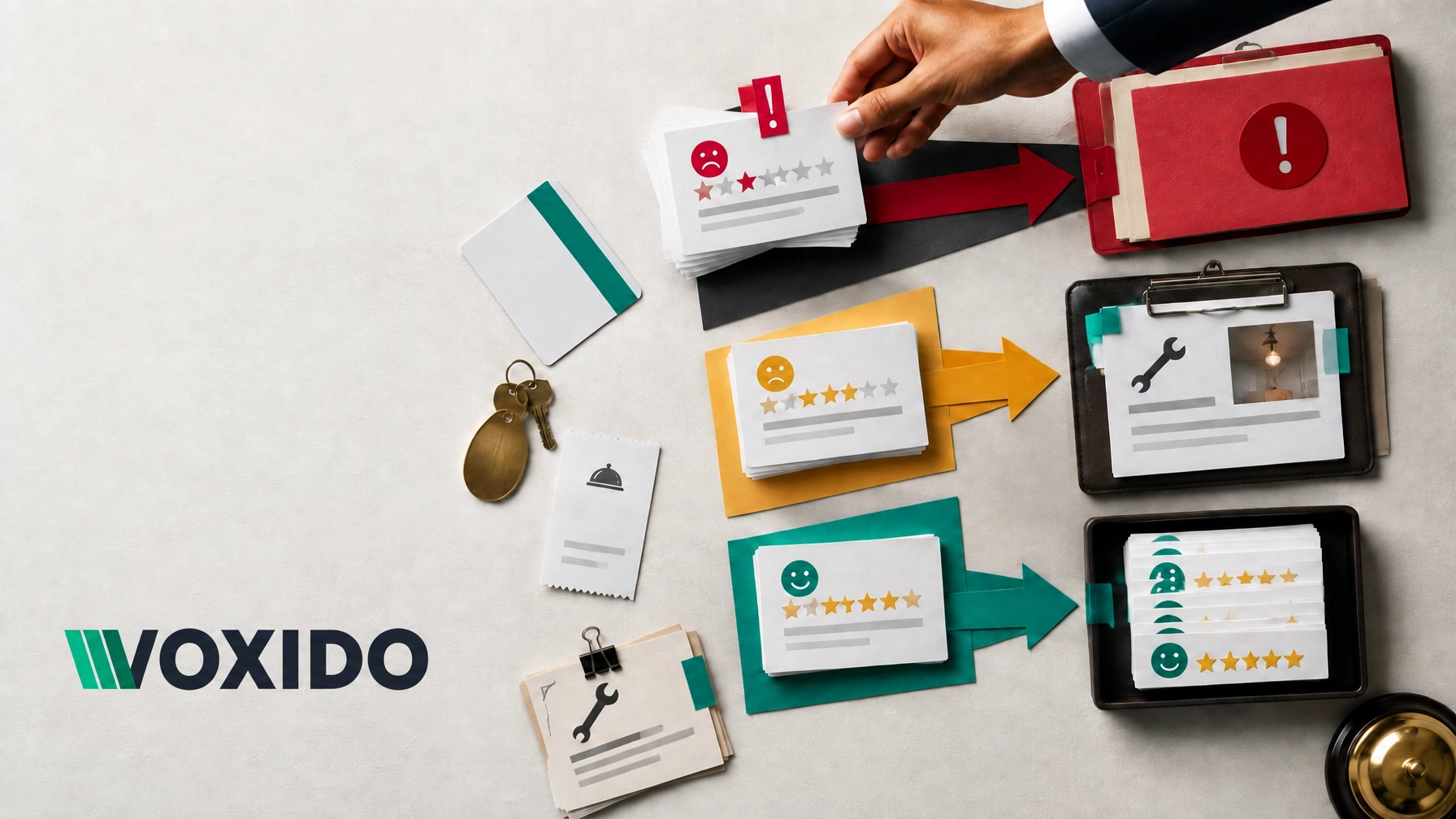
Not necessarily. Every review should enter your workflow, but not every review deserves the same response speed, approval path, or amount of personal attention. The practical goal is to prioritise reviews by risk and business value while ensuring routine feedback is not forgotten.
For most hotels, the right system combines five signals:
- Severity: How serious is the complaint?
- Recency: Is the issue new or still relevant?
- Topic: Does it point to a recurring operational problem?
- Guest-identifiable service issue: Can your team recognise and recover the stay?
- Response ownership: Who can make or approve the next decision?
The result is not “reply to everything immediately.” It is a controlled process that protects reputation, gives managers visibility, and turns reviews into operational work.
What the evidence says about review responses
A Cornell Center for Hospitality Research report by Chris Anderson and Saram Han, “Hotel Performance Impact of Socially Engaging with Consumers,” was published in May 2016. One part of the study examined 2015 TripAdvisor data from 65,195 hotels in four markets—Dubai, France, Italy, and the UK. It found a relationship between management response rates and revenue generated through TripAdvisor referrals, with diminishing returns estimated around a 40% response rate.
The report also analysed three years of data from just over 7,400 quarterly hotel observations in New York City and 3,600 in Orlando. Responses to negative reviews were more positively related to rating changes than responses to positive reviews.
These findings are useful directionally, not as a universal target. The authors explicitly caution that the analysis is correlational, not causal. A hotel should not treat 40% as a recommended ceiling or assume that responding to fewer reviews will automatically improve revenue. The practical lesson is simpler: prioritise thoughtful responses to meaningful negative feedback before spending equal effort on routine praise.
Read the original Cornell report.
A five-step review triage workflow
1. Trigger: bring every new review into one queue
Audience: The GM, reputation manager, front office manager, guest relations lead, and department owners.
Trigger: A new review arrives on Google, an OTA, or another review source.
Information required:
- Review date and channel
- Star rating
- Review text
- Guest name or booking reference, if available and permitted
- Stay dates
- Room or booking details
- Mentioned department or service
- Previous complaint or recovery history
- Any safety, billing, privacy, discrimination, or legal language
The review should first be recorded as a request for attention, not as a completed task. The system may identify sentiment, topic, severity, and likely root cause, but a person or approved workflow must still decide what should happen next.
2. Prioritise by severity, recency, and topic
Use three practical tiers.
| Priority | Typical reviews | Suggested timing choice | Primary owner |
|---|---|---|---|
| Urgent | Safety, discrimination, privacy, billing disputes, legal threats, serious illness or injury allegations, very recent unresolved complaints | Same shift or within 24 hours | GM or designated senior manager |
| High | One- or two-star reviews, detailed service failures, repeated operational problems, recent complaints on high-visibility channels | Within 24–48 hours | Guest relations or front office manager |
| Routine | Short positive reviews, general praise, older low-detail feedback | Within 48–72 hours, or batched during a scheduled review block | Reputation manager or approved responder |
These timings are choices, not universal service-level requirements. A hotel should adjust them to staffing, channel visibility, local expectations, and the seriousness of the issue.
Severity should outrank star rating. A four-star review mentioning a privacy concern may require faster escalation than a one-star review complaining about breakfast variety.
Recency also matters. A complaint posted yesterday about an unresolved air-conditioning problem deserves more attention than an old review about a repair that has already been completed.
3. Accept ownership before drafting a reply
A department label is not enough. Assign one accountable person.
The workflow should record:
- Request: A review needs assessment or response.
- Accepted ownership: A named manager accepts responsibility.
- Recorded decision: The team decides whether to reply, investigate, recover, or monitor.
- Guest notification: The hotel sends a public reply or private follow-up where appropriate.
- Completion: The response is published and the internal action is closed: or remains clearly marked as pending.
For example, housekeeping may own the investigation into a cleanliness complaint, but the guest relations manager may own the public response. The GM may need to approve a reply involving safety, compensation, discrimination, or legal language.
This distinction prevents a common failure: a review is “assigned” to a department, everyone assumes someone else is handling it, and no guest receives an answer.
4. Resolve the service issue before making promises
For a serious or guest-identifiable complaint, check the facts before publishing.
The owner should review the reservation record, front desk notes, maintenance logs, billing details, and any prior conversation. The hotel should then decide what it can truthfully say.
A public reply should generally:
- Thank the guest for sharing feedback.
- Acknowledge the specific issue.
- Apologise where the hotel fell short.
- State the action already taken, if confirmed.
- Invite a private conversation for personal details.
- Avoid discussing confidential information, blame, or unverified explanations.
Do not write “we have fixed this permanently” when the team has only opened an investigation. A recorded decision to investigate is not the same as completion.
The main exception is a case involving safety, legal exposure, sensitive personal information, or a dispute over money. Those should move to the GM, owner, legal adviser, or other designated senior person before the hotel publishes anything.
5. Close the loop with an operational action
A reply is not the end of the workflow.
At least once per week, group reviews by topic and root cause:
- Check-in delays
- Housekeeping quality
- Noise
- Breakfast
- Wi-Fi
- Maintenance
- Billing
- Staff communication
- Room description or expectation gaps
For each repeated issue, record an action owner, next decision date, and outcome metric. Possible measures include response time, percentage of reviews with a recorded decision, unresolved high-priority cases, complaint volume by topic, rating trend, and repeat occurrence of the same root cause.
The question is not only “Did we reply?” It is also “Did the operation learn anything?”
A reusable review-response checklist
Before publishing, ask:
- Have we identified the exact complaint or compliment?
- Is the review recent, high-visibility, or linked to an active stay?
- Does it mention safety, privacy, billing, discrimination, or legal action?
- Have we checked the relevant reservation and department records?
- Is ownership accepted by a named person?
- Is the proposed reply accurate and free of private guest information?
- Does it distinguish what is completed from what is still being investigated?
- Does the case need GM approval?
- Has the guest been notified through the appropriate public or private channel?
- Is there an internal action and a completion state?
- Should the topic be added to the weekly operations review?
Worked example: an illustrative assumption
Assumption: A 120-room hotel receives a two-star Google review on Monday morning. The guest says the room was not ready at check-in, the air conditioning failed overnight, and the front desk did not provide an update.
Trigger: New low-star review on a high-visibility channel.
Audience: GM, front office manager, housekeeping, and maintenance.
Information required: Reservation and arrival time, room-readiness log, maintenance ticket, front desk notes, and any prior guest messages.
Timing choice: The front office manager accepts ownership within the same shift. The GM reviews the draft within 24 hours.
Action: Maintenance confirms whether the air-conditioning issue was logged and resolved. Front office checks the missed update. The hotel posts an accurate apology and invites the guest to continue privately.
Exception owner: The GM handles any compensation request or allegation of serious harm.
Exit state: The public reply is published, the operational actions are assigned, and the case remains open until the internal review is complete. “Reply published” and “problem fixed” are recorded separately.
Outcome metrics: Response time, time to accepted ownership, time to operational closure, repeat air-conditioning complaints, and rating trend for the topic.
Where automation can help
A reputation workflow can reduce manual sorting without removing human judgement. Voxido’s reputation-management workflow supports Google and OTA review connections or CSV import, analysis of sentiment, topics, severity, and root cause, AI-drafted replies, manager routing for low-star reviews, an action centre, and trend or competitor views.
That makes it a possible fit for hotels that need a central review queue and clearer handoffs. It does not remove the need for property-specific policies, approval rules, fact-checking, or service recovery ownership.
Hotels already building structured guest communication processes may also find the same trigger-owner-exception logic useful in their broader automated guest communication workflow.
The operating decision
Do not measure review management only by reply rate.
Measure whether the hotel:
- Sees every important review
- Responds to serious issues quickly
- Gives each case one accountable owner
- Avoids unsupported promises
- Completes the operational follow-up
- Reduces repeated complaints over time
The best workflow is not “reply to every review at any cost.” It is triage every review, respond where the guest and business need it most, and turn recurring feedback into owned operational work.
If you want to assess whether this workflow fits your hotel’s review volume, channels, and escalation rules, bring your scenario to Voxido.
Leave a Reply